


Exhibitors①
Japan Geoscience Union
Japan Geoscience Union
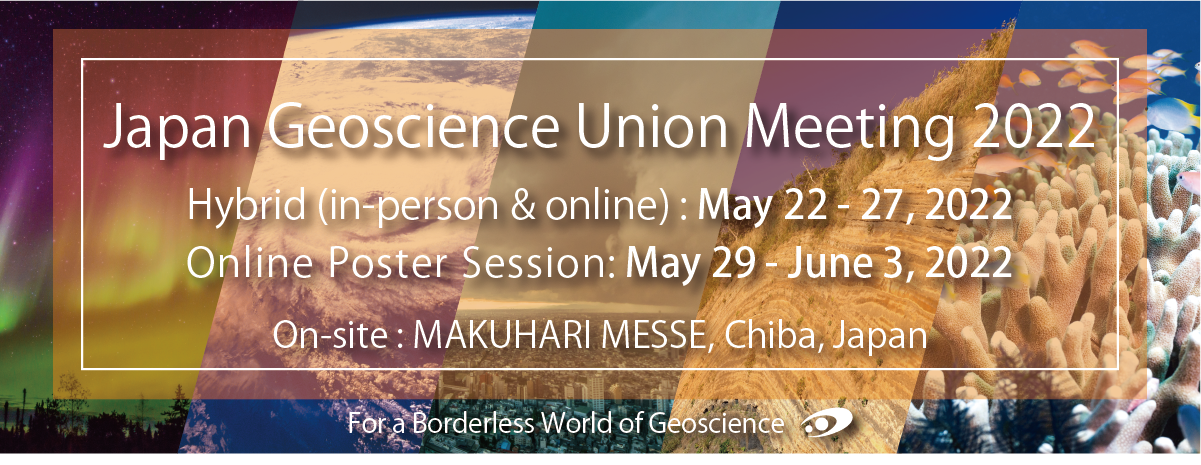
JpGU2022 will be held as a hybrid format (on-site and online) next May at the Makuhari Messe, Chiba Prefecture, Japan, It is aimed that all participants can attend JpGU2022 at the conference rooms and/or from anywhere through network. This is a first attempt for JpGU.
Link

| Address | 113-0032 4F Gakkai Center Bldg., 2-4-16 Yayoi, Bunkyo-ku, Tokyo 113-0032, Japan |
|---|---|
| Web site, SNS | http://www.jpgu.org/meeting_e2022/ |
ISEE, Nagoya University
ISEE, Nagoya University

What is the Institute for Space-Earth Environmental Research (ISEE)
The mission of ISEE is to clarify the mechanisms and relationships between the Earth, the Sun, and cosmic space, treating them as a seamless system, and to contribute to solving issues related to the global environment and human society spreading in space. In addition, ISEE plays a role as the only joint usage/research center linking space science and earth science, and promotes various collaborative research projects.
Our environment comprises various interacting elements and evolves with time. In particular, the dynamics of solar activity sometimes have a great influence on the global environment and human society. A huge solar flare explosion occurring on the solar surface severely disturbs the Earth's magnetic field, the atmosphere, and the radiation environment, and it may cause serious impacts on satellites, electric power, communications, aviation, and other infrastructure. Long-term variation in sunspot activity may also affect the global climate. Cosmic rays arriving from far away in the universe are also an element of our environment, and the cosmogenic isotopes in tree rings provide us with valuable information to explore past environments. On the other hand, it is important to understand the mechanisms of climate change and extreme weather phenomena, both of which may cause disasters. For this purpose, it is necessary to clarify not only the greenhouse effect but also the hydrological circulation, in which aerosols, clouds, and precipitation interact, as well as the interaction between meteorological dynamics and the land–ocean ecosystem with solar influence.
In order to explore the space–earth environment, interdisciplinary research across different fields is necessary. ISEE aims to play a role in promoting domestic and international research collaboration between researchers, and to develop a new discipline of space–earth environmental research. We look forward to your continued support and cooperation.
Education at ISEE
ISEE offers primarily graduate programs (Graduate School of Science, Graduate School of Engineering, and Graduate School of Environmental Studies in Nagoya University), but also provides opportunities for both undergraduate and postdoctoral study.
Link to Education page at ISEE HP
Outreach activities at ISEE
For purposes of science education, ISEE publishes booklets on many topics in space science. These publications include comic books written by the popular cartoonist "Hayanon," featuring humorous characters and explaining scientific themes in a friendly way. The booklets are suitable for the general public as well as for school children. ISEE publishes these booklets in collaboration with SCOSTEP. These booklets can be downloaded at the following site.
Link to outreach page at ISEE HP
| Web site, SNS | https://www.isee.nagoya-u.ac.jp/ |
|---|
Japan Synchrotron Radiation Research Institute (JASRI)
Japan Synchrotron Radiation Research Institute (JASRI)

We introduce various researches at SPring-8 and SACLA,and how to use the facilities by exhibit.
Please contact us anytime for about any question and something about SPring-8 and SACLA.
Contact: Japan Synchrotron Radiation Research Institute (JASRI) User Administration Division
e-mail:jasri-event@spring8.or.jp
Water, Everywhere: Scientists Find Liquid Water in an Ancient Meteorite
-BL47XU(HAXPES/uCT)
Water is abundant in our solar system. Even outside of our own planet, scientists have detected ice on the moon, in Saturn’s rings and in comets, liquid water on Mars and under the surface of Saturn’s moon Enceladus, and traces of water vapor in the scorching atmosphere of Venus.
SPring-8 User Information
SACLA User Information
| Address | 679-5198 1-1-1 Kouto, Sayo-cho, Sayo-gun, Hyogo 679-5198, JAPAN |
|---|---|
| TEL | 0791-58-2785 |
| FAX | 0791-58-2786 |
| Web site, SNS | http://www.spring8.or.jp/en/ |
Paleo Labo co.,ltd.
Paleo Labo co.,ltd.

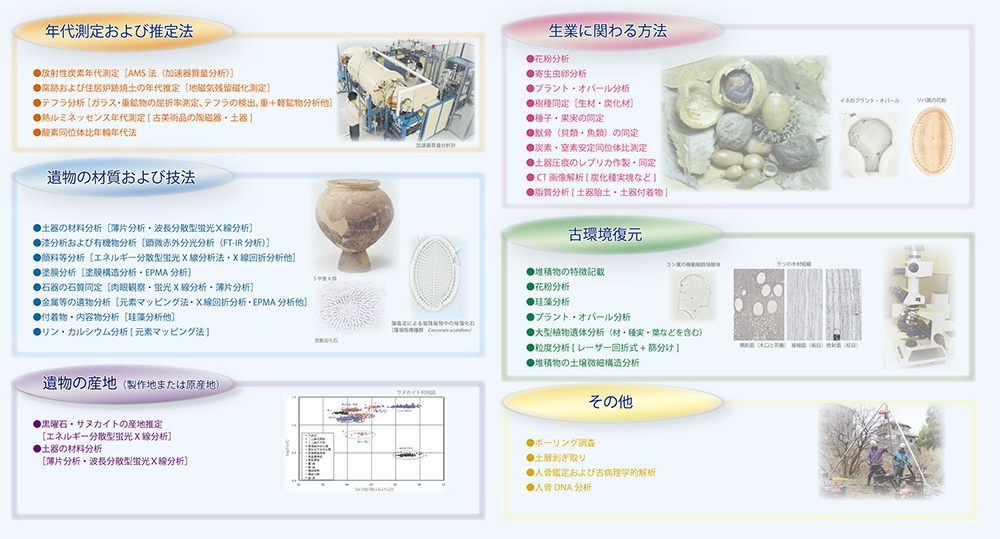
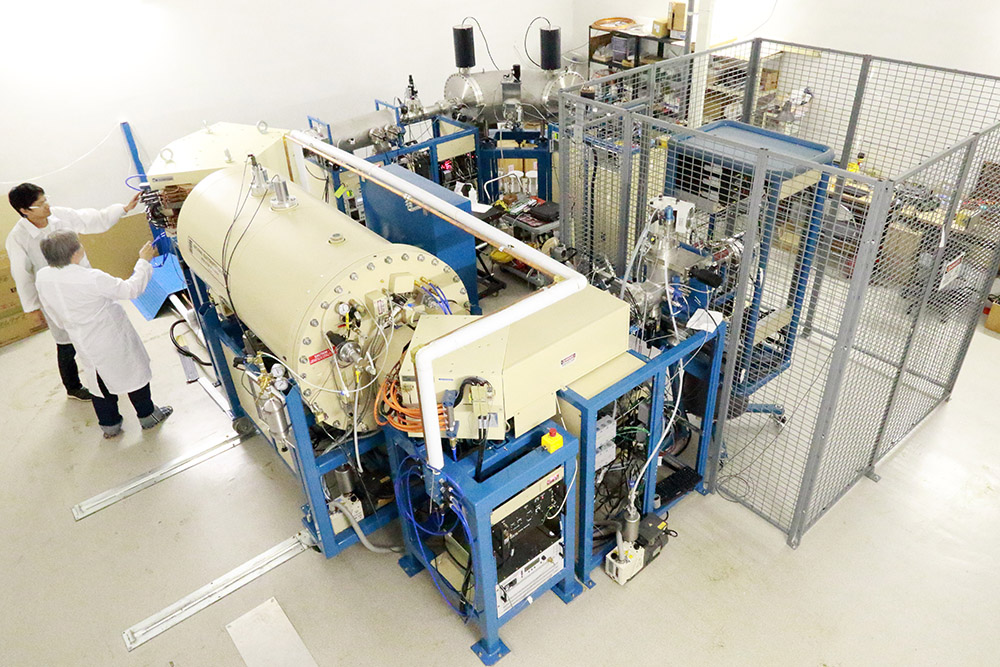
Download Pamphlet
a. ¥300,000 research grant
b. 10 radiocarbon dating samples for free
Acceptable period: September 1, 2022 to October 31, 2022 and April 1, 2023 to August 31, 2023
2. Submission deadline
July 31, 2022 (must arrive)
Please contact us for further information: jyosei@paleolabo.jp
| Address | 335-0016 1-13-22, Shimomae, Toda, Saitama, 335-0016, Japan |
|---|---|
| TEL | 048-446-2345 |
| FAX | 048-444-7756 |
| Web site, SNS | https://www.paleolabo.jp/English_site/e-toppage.html |
Newtech
Newtech
Knowledge Foresight Inc.
Knowledge Foresight Inc.

YureMON, I-MON (Earthquake Observation System), KanTen (Meteorological Observation System)
"YureMON" and "I-MON" are remote monitoring services that can measure vibrations such as earthquakes and display them on the Web. Using these services with "KanTen", a service that displays weather data on the web, a real monitoring service for both earthquakes and weather is realized.
| Address | 152-0022 東京都目黒区柿の木坂1-30-17 モナーク都立大6F |
|---|---|
| TEL | 03-5729-2838 |
| Web site, SNS | https://knowledgeforesight.com |
NEC
NEC

Japan Agency for Marine-Earth Science and Technology
Japan Agency for Marine-Earth Science and Technology
To reveal earthquakes and volcanic activities, the scientists and staff of the Research Institute for Marine Geodynamics will conduct large-scale observations around Japan and the western Pacific using JAMSTEC vessels and various state-of-the-art marine exploration technologies. In particular we will conduct geophysical-geological surveys in the Nankai Trough, Japan Trench, Kuril Trench, and other tectonically active zones that may be subject to a forthcoming megathrust earthquake or volcanic eruption. Moreover, we will develop, improve, and upgrade the methods and systems to acquire and process data.
Furthermore, in line with SDGs 11 (sustainable cities and communities), our institute will contribute to disaster mitigation by sharing the scientific knowledge we have gained with society. We will also endeavor to conduct observational surveys and apply our research results in countries that are vulnerable to frequent natural disasters such as earthquakes, tsunamis, and volcanic activities.
・JAMSTEC Research Institute for Marine Geodynamics (IMG)
・Pamphlet (PDF 2.19MB)
EARTH SIMULATOR
| Address | 237-0061 2-15, Natsushima-cho, Yokosuka-city, Kanagawa, 237-0061, Japan |
|---|---|
| Web site, SNS | https://www.jamstec.go.jp/e/ |
Department of Earth and Planetary Science, Graduate School of Science, The University of Tokyo
Department of Earth and Planetary Science, Graduate School of Science, The University of Tokyo
We reorganized the four departments, Earth and Planetary Physics, Geology, Mineralogy, and Geography, into the Department of Earth and Planetary Science in 2000 both for the enhanced research across the breadth of earth and planetary science and for more flexible and effective graduate and undergraduate education.
The five core research groups in the department, Atmospheric and Oceanic Science, Space and Planetary Science, Earth and Planetary System Science, Solid, and Earth Science, Geosphere and Biosphere Science, are in cooperation with each other as well as with affiliated institutions* to be the core institute for both research and education in Earth Planetary Science in Japan. (*The affiliated institutions in the University of Tokyo are the Ocean Research Institute, the Earthquake Research Institute, the Institute of Solid State Physics, the Center for Climate System Research, the Center for Spatial Information Science, the Research Center for Advanced Science and Technology, the University Museum, the Graduate School of Frontier Sciences, the Graduate School of Arts and Sciences, the Laboratory for Earthquake Chemistry, the Department of Astronomy and the Department of Physics. The Japan Aerospace Exploration Agency and the High Energy Accelerator Research Organization, both of which are not the institutions in the University of Tokyo, are also in partnership with us.)
The educational program aims to train doctoral-level researchers who can become leading figures in their respective fields and masters-level students and undergraduates who will take a variety of positions in government, industry, and education, where it is hoped that they will be able to make significant contributions to society.
Another important objective of the department is to contribute directly to society through participation in national and international programs of applied research in areas such as global climate change or mitigating earthquake hazards.
| Address | 1130033 7-3-1, Hongo, Bunkyo-ku, Tokyo, Japan |
|---|---|
| Web site, SNS | https://www.eps.s.u-tokyo.ac.jp/en/ |
Science of Slow-to-Fast Earthquakes
Science of Slow-to-Fast Earthquakes

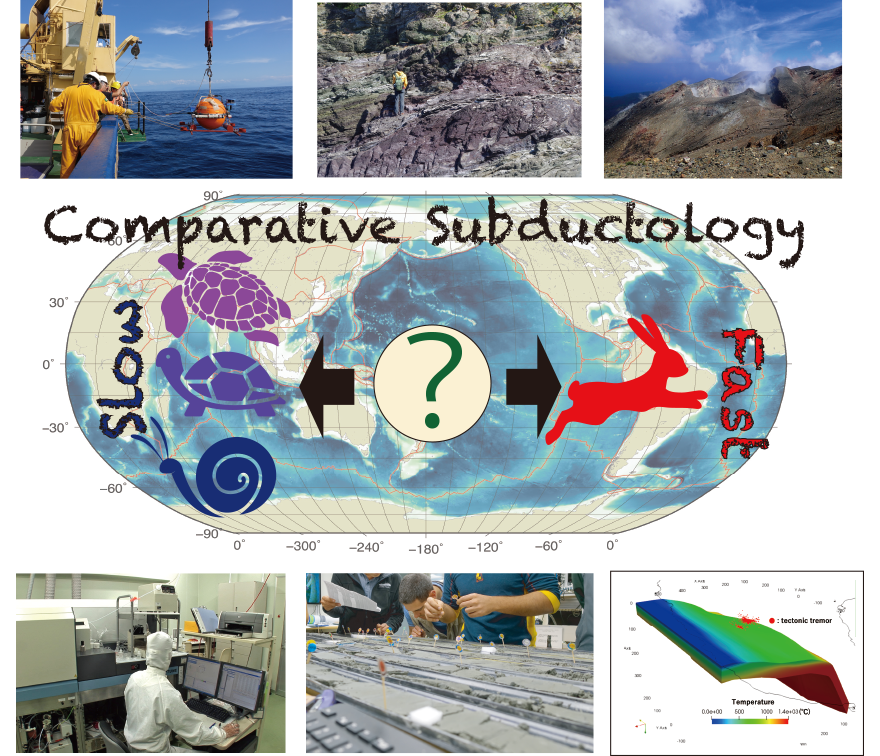
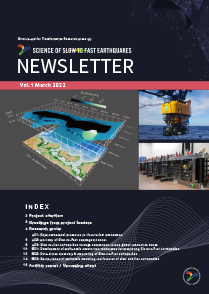
Show PDF
①26 May (Thu.) PM1, PM2 1:45pm~5:00pm (JST)
②27 May (Fri.) AM1, AM2, PM1, PM2 9:00am~5:00pm (JST)
【On-site Poster Session】Poster room
③26 May (Thu.)PM3 1:00pm~2:00pm (JST)
【Online Poster Phase】
④3 June (Fri.) 11:00am~1:00pm (JST)
[Date] Sep. 14(Wed.)-16(Fri.), 2022
[Venue] Nara Kasugano International Forum
[Details] TBD
[Website] https://en.slow-to-fast-eq.org/news/international-joint-workshop-on-slow-to-fast-earthquakes-2022/
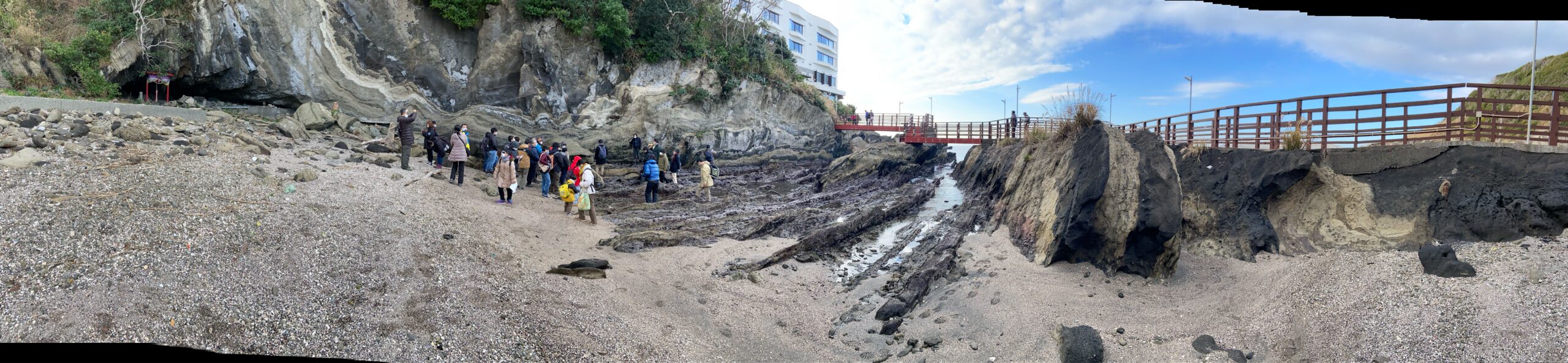

| Address | 1130032 東京都文京区弥生1-1-1 東京大学地震研究所内 |
|---|---|
| Web site, SNS | http://en.slow-to-fast-eq.org/ |
National Astronomical Observatory of Japan,TMT Project /ALMA Project
National Astronomical Observatory of Japan,TMT Project /ALMA Project
ALMA project
TMT is an ambitious project with plans to construct on Hawai`i an extremely large telescope with an aperture of 30m with the cooperation of five countries including Japan. The major goals of TMT include search for signatures of life on extrasolar planets and the history of our solar system.
◆TMT Overview
・Aperture:30 meters / 492 segment mirrors
・Wavelength range:0.31-28μm
・Diffraction limit:8miliarcsec (at 1μm)
・Sensitivity:More than 100 times better than conventional telescopes
(when observing a point light source with adaptive optics)
English Brochure (PDF, 2MB)
In Search for Life on Extrasolar Planets
Our Solar System
Science Teams
Maunakea and TMT
Many planetary systems around stars other than our Sun are being discovered today, and we are learning that there exist planets with various sizes and orbits. Recently, planets similar in size as Earth have been discovered, indicating that there are planetary systems much like our own Solar Sytem. Today, infrared observation has advanced to a point of being able to actually capture images of these planets.
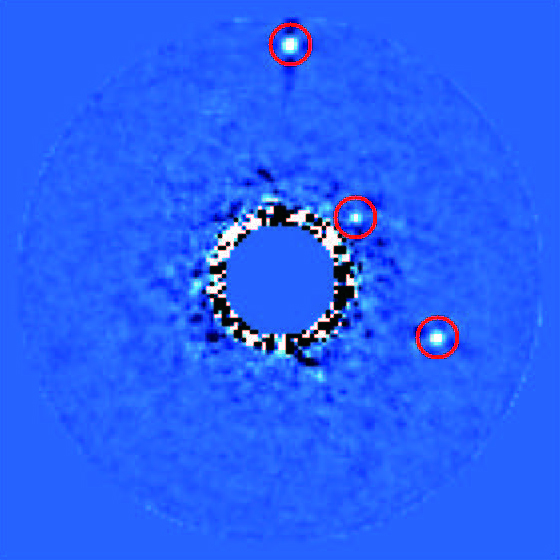
Three Jupiter-like planets around HR8799 discovered by the Subaru Telescope (in red circle). TMT will attempt to directly capture even smaller Earth-like planets. (Credit: CHARIS Team of Princeton University, and NAOJ)
◆Are we alone?
Are there extrasolar planets with existence of life? This is a question common to all humanity. TMT aims to discover signs of life on these planets.
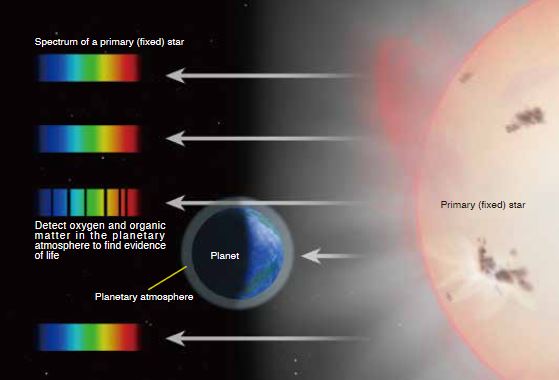
TMT will be able to study the composition of the atmosphere of extrasolar planets through spectroscopic observation. Discovery of oxygen molecules and organic substances could be a signature of existence of extra-terrestrial life.
Exoplanets with TMT (TIO website)
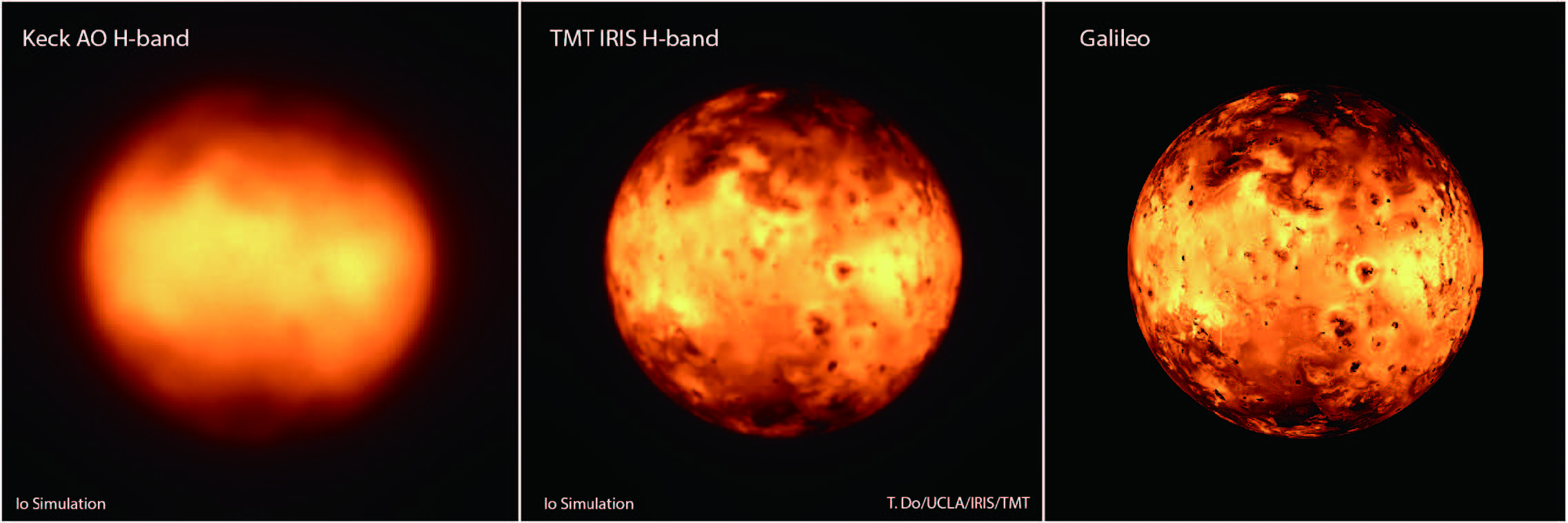
The view of Jupiter's moon Io when observed using adaptive optics. The image on the left is a simulation of a conventional telescope with an aperture of 8 to 10 meters, and the image in the center is a simulation of TMT. The image on the right is the actual image taken by the Galileo spacecraft (Credit: T. Do/UCLA/IRIS)
Our Solar System with TMT (TIO website)
ISDTs (TIO website)
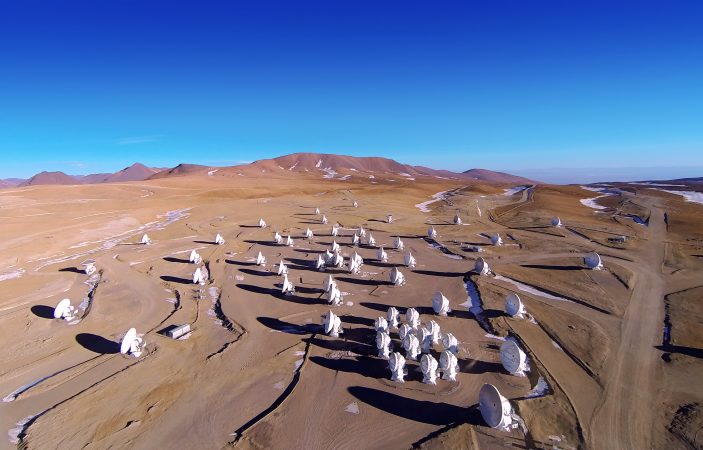
These long asked questions of the universe still remain a mystery, but they are about to be solved by the world’s most advanced telescope ALMA, a giant telescope that was constructed at an altitude of 5,000 meters in Chile and started its scientific observations from 2011. With a visual acuity of 120,000/20, ALMA is capable of capturing overwhelmingly high quality images of very weak radio waves emitted by gas and dust from which stars and planets are formed and materials that could be building blocks of life.
ALMA has a mission to unveil the mechanism of planet formation and to find a clue to the origin of life in global partnership of 22 countries and regions including Japan. Here, you can get the picture of grand mysteries of the universe to be explored by ALMA and astronomical endeavors to address such big scientific challenges with ALMA.
Stars shining in the night sky emit visible light with a high surface temperature of several thousands to several tens of thousands degrees. Optical telescopes like Subaru can capture light emitted from stars.
On the other hand, the temperature of planet-forming dust and gas and amino acids contained in gas is minus 260 degrees Celsius, which is too cold to emit light. ALMA receives radio waves emitted from dust and gas, and amino acids, to reveal the distribution and characteristics of materials that form galaxies, stars, and planets, as well as the building blocks of life.
ALMA observations cover a range of wavelengths called “millimeter/submillimeter” waves. There are other existing telescopes that observe millimeter/submillimeter waves, but ALMA is an outstanding telescope with exceptionally high sensitivity and resolution capable of imaging the unknown universe that was never possible to see before.
About ALMA
ALMA 10th Anniversary
| Address | 1818588 2-21-1 Osawa, Mitaka, Tokyo 181-8588, JAPAN |
|---|---|
| Web site, SNS | https://alma-telescope.jp/en/ |
Arctic Challenge for Sustainability II
Arctic Challenge for Sustainability II

ArCS II is a project that aims to promote advanced and interdisciplinary research on the Arctic, aiming for the social implementation of the results. In this exhibition, you can enjoy a variety of contents about the Arctic and Arctic research through hands-on experience.
What is the Arctic?
The Arctic region is where the impact of global warming is most evident. Although the Arctic is far away from Japan, its environmental changes are actually having a significant impact on Japan as well. We will introduce what the arctic environment is and what changes are occurring there, along with research activities in Japan.
What is ArCS II ?
Under four Strategic Goals, 11 Research Programs – including natural sciences, engineering, humanities, and social sciences – collaborate each other on ArCS II project.

Click here to know more about ArCS II.
Click here if you want to explore Activity Map of ArCS II Project WEB version
Challengers of Arctic Research
Arctic research encompasses not only natural sciences but also humanities and social sciences, and researchers are active in a wide range of fields. Here we introduce you to the researchers working in the field of Arctic research.
Click following links to know about the results of ArCS II
In Japan, there are many research institutes conducting Arctic research, including the National Institute of Polar Research, JAMSTEC, and Hokkaido University. Here we introduce some of the major research institutions participating in ArCS II.※Please enable and use Google My Maps.
Early Career Researchers talking about Arctic Research!
ArCS II is providing the "Overseas Fellowship Program" to support young researchers who are interested in Arctic research at overseas institutes. Here are some interviews with past participants.
Click here to watch other interviews.
Applications for the 2nd Overseas Visit Program for Young Talent in FY2022 will open in mid-June. For more information, please click here.
I want to know more! About the Arctic
How is the environment in the Arctic changing? Use Dagik Earth, a digital globe, to see the sea ice extent, sea surface temperature, snow depth, changes in surface temperature and black carbon concentration, and projected changes in temperature and sea ice. You can see what's happening not only in the Arctic, but also in other area of the world.
Click here to explore the Arctic with Dagik Earth
Here is the first report of the 2022 sea ice forecast released in May. The report forecasts the opening of the Arctic sea route and the distribution of sea ice until September, when the sea ice extent will be at its minimum.
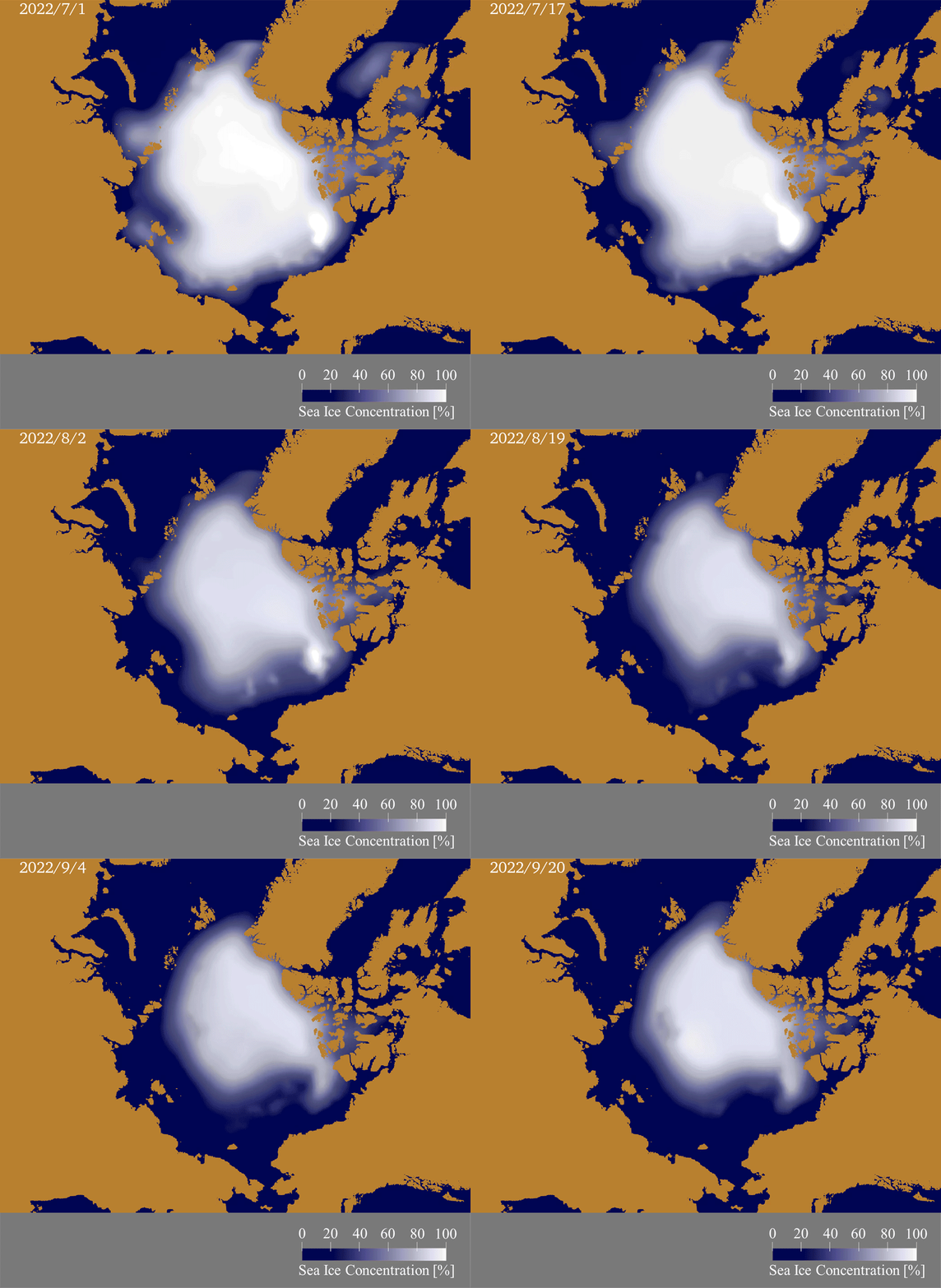
Click here to learn more about Arctic sea ice.
In the future, ArCS II plans to conduct a variety of education and outreach activities.

Click here if you want to know more about education and outreach activities of ArCS II.
Arctic Advisory Room
If you have any questions about the Arctic, Arctic research, or this exhibit, please feel free to contact us using the form below.
JpGU2022 Arctic Advisory Room
| Address | 190-8518 10-3, Midoricho, Tachikawa, Tokyo |
|---|---|
| TEL | 042-512-0922 |
| FAX | 042-528-3195 |
| Web site, SNS | https://www.nipr.ac.jp/arcs2/e/ |
Hiroshima Institute of Plate Convergence Region Research (HiPeR)
Hiroshima Institute of Plate Convergence Region Research (HiPeR)

Hiroshima Institute of Plate Convergence Region Research (HiPeR) is a research center that has been certified as “Centers of Excellence” in Hiroshima University. The staff of the Department of Earth and Planetary Systems, Hiroshima University play a central role in promoting active joint research and educational activities.
<Flyer>
Different important geoscientific phenomena caused by the dynamic processes are occurring frequently and actively at the plate convergence areas on the Earth. HiPeR (Hiroshima Institute of Plate Convergence Region Research) aims to have comprehensive understanding on these important phenomena, dividing them into three major processes of strategic research. These include “deep circulation of rocks and water”, “process and mechanism of fault movements” and “processes of magma generation”. We are aiming to carry out three-pronged research activities including “experiments”, “instrument-based observations” and “fieldwork-based observations”, which would help us to achieve the unified goal of better understanding of plate convergence area materials and events. Please see the below for the details.
<Member>
We, the staff of the Department of Earth and Planetary Systems, Hiroshima University, are promoting active joint research and educational activities with the participation of many members from Japan and overseas. Please see the below for the members of the research center.
Please click the below URL to see the above enlarged poster.
https://drive.google.com/file/d/1MGCIHxEe5GSeXOQa_BYj3VHK93wClWAE/view?usp=sharing
<Activity>
The followings introduce some of the activities of the research center.

Please click the below URL to see the above enlarged poster.
https://drive.google.com/file/d/1uWFJkxfKLh2XbIUOBwk0vtUTs3JWDPiA/view?usp=sharing
| Address | 739-8526 Kagamiyama 1-3-1, Higashi-Hiroshima 739-8526, Japan |
|---|---|
| TEL | 082-424-7460 |
| FAX | 082-424-0735 |
| Web site, SNS | http://hiper.hiroshima-u.ac.jp/en/ |
TOYO Corporation (Ocean Measurement Technology Division)
TOYO Corporation (Ocean Measurement Technology Division)

| Address | 103-8284 1-6,Yaesu 1-chome, Chuo-ku, Tokyo |
|---|---|
| TEL | 03-3245-1243 |
| FAX | 03-3246-0645 |
| Web site, SNS | https://www.toyo.co.jp/english/business/segments/kaiyo/ |
Geological Survey of Japan, AIST
Geological Survey of Japan, AIST
| Address | 305-8567 茨城県つくば市東1-1-1 中央第 7 |
|---|---|
| TEL | 029-861-3540 |
| Web site, SNS | https://www.gsj.jp/en/index.html |