


Exhibitors④
Japan Meteorological Agency
Japan Meteorological Agency
Contents
Contents
Download
Contents
①× ×, 2021(×)13:00~14:00
②× ×, 2021(×)13:00~14:00
Please click here to contact us (Zoom will start)
| Address | 105-8431 3-6-9 Toranomon, Minato City, Tokyo |
|---|---|
| TEL | 03(6758)3900 |
| Web site, SNS | https://www.jma.go.jp/jma/indexe.html |
Department of Earth and Planetary Science, The University of Tokyo
Department of Earth and Planetary Science, The University of Tokyo
Contents
Contents
Download
Contents
①× ×, 2021(×)13:00~14:00
②× ×, 2021(×)13:00~14:00
Please click here to contact us (Zoom will start)
Sanyo trading/Picarro Isotopic Water Analyzer
Sanyo trading/Picarro Isotopic Water Analyzer

Contents
Contents
Download
Contents
①× ×, 2021(×)13:00~14:00
②× ×, 2021(×)13:00~14:00
Please click here to contact us (Zoom will start)
| Address | 1100015 東京都千代田区神田錦町2-11 |
|---|---|
| TEL | 03-3518-1196 |
| FAX | 03-3518-1203 |
| Web site, SNS | https://www.sanyo-si.com/ |
SGS Beta
SGS Beta

*Free, unlimited technical support
*Secure online access to results, sample photos, and QA reports
*Prompt response to inquiries within 24 hours, customer support in 9 languages
*Results are published in highly regarded academic journals
*ISO IEC17025:2017 accredited
Why Choose a Tracer-Free Laboratory for Carbon-14 Analysis?
| Address | 4985 S.W. 74th Court Miami, FL USA 33155 |
|---|---|
| TEL | Japan (+81)52-802-0703 , USA HQ (+1) 305-667-5167 |
| Web site, SNS | https://www.radiocarbon.com |
Marine Works Japan Ltd.
Marine Works Japan Ltd.

| Address | 237-0063 3-54-1 Oppamahigashi, Yokosuka, Kanagawa, Japan |
|---|---|
| Web site, SNS | https://www.mwj.co.jp/ |
INPEX CORPORATION
INPEX CORPORATION
Contents
Contents
Download
Contents
①× ×, 2021(×)13:00~14:00
②× ×, 2021(×)13:00~14:00
Please click here to contact us (Zoom will start)
TCGU
TCGU

◆TCGU
Introduction of TCGU
Geoscience is a synthetic basic and applied science that includes several specific disciplines, including geology, geophysics, meteorology, oceanography, etc. Each of these disciplines has enjoyed a rather long history of development in the Republic of China. Because, in the past, researches in these fields were undertaken in hand with our country’s overall economic development, they tended mostly toward applied results, and purely academic results were rather limited. But, during the past two decades, researchers have worked hard, with the strong support of concerned government agencies, to carry out all sorts of overall large-scale research, for example, on earthquakes, monsoons, the Kuroshio current, etc. No matter whether in our local studies or in our international survey researches, these research plans have yielded a rich harvest of solid results.
In the past, scholarly articles in these specific academic disciplines generally tended to be published in periodicals of local academic associations or departments and graduate institutes, which suffered from an insufficient supply of manuscripts, limited publication quantity, and small circulation. In view of this situation, the Natural Science Division of the National Science Council invited responsible scholars from each concerned academic association to come together to discuss the establishment of a journal able to represent our country’s achievements in geosciences. With this combining of the specific fields, the supply of manuscripts would be ample and the standard of strictness of the manuscript review system would be strengthened; thus, this journal’s contents would be well-qualified to be recorded in SCI. In this way, developments in domestic geoscience would keep pace with those in domestic mathematics, physics and chemistry. The Chinese Meteorology Society, Geology Society, Topology Society, etc., all generously approved of this plan and cooperated in the official publication of Terrestrial, Atmospheric and Oceanic Sciences, or simply TAO, in March 1990.
Ever since its inception, TAO has enjoyed steady growth; each year four issues have appeared. Scholars from various concerned fields were recommended to set up a Consulting Committee to cooperate and solve the journal administrative matters during the early period of publication, and the Editorial Committee reviewed manuscript submissions according to strict academic standards. In recent years, TAO has encouraged scholars to publish their large-scale National Science Council research plan results in special monographs, in order to facilitate interactive learning by discussion. From another perspective, TAO has received special attention from international scholars for its publication of many important local survey materials and discussions of causes and results. Consequently, we have received many letters requesting to subscribe as well as many letters from other geoscience journals requesting journal exchanges.
For even more effective operations, the Consulting Committee of the Chinese Geoscience Union in Taiwan recommended harnessing all the forces in geosciences by establishing an office, appointing personnel and purchasing special software equipment, so TAO contents could be more quickly recorded in SCI. In this way, too, TAO would become the main academic journal for local environmental research by local scholars, and would provide a complete record of developments in geoscience in our country. In addition, the Union could more effectively endeavor to harness scholars in the various concerned disciplines to work together in actively developing overall geoscience research projects to meet all sorts of environmental problems of the 21st century. In these ways, it was thought that TAO could improve the standard of academic research in geosciences in this country as well as improve the quality of people’s life here.
On September 29, 1992, the Union received Ministry of the Interior approval to form; then, on January 16, 1993, a large inaugural convention was held to establish the Union. The name “Chinese Geoscience Union in Taiwan” was formally adopted.
Journal Overview
Journal Overview
The major publication of the Chinese Geoscience Union in Taiwan (located in Taipei) since 1990, the journal of Terrestrial, Atmospheric and Oceanic Sciences (TAO) publishes scientific research articles, notes, correspondences and reviews in all disciplines of the Earth sciences. It is the amalgamation of the following journals:
- Papers in Meteorological Research (published by the Meteorological Society of the ROC) since Vol. 12, No. 2
Bulletin of Geophysics (published by the Institute of Geophysics, National Central University) since No. 27
Acta Oceanographica Taiwanica (published by the Institute of Oceanography, National Taiwan University) since Vol. 42
TAO is co-sponsored by the Geological Society, the Geophysical Society, the Meteorological Society, and the Oceanographic Society of the Republic of China (ROC) and has its publication partially subsidized by the National Science and Technology Council of the ROC. TAO has been selected for coverage by the Science Citation Index® (SCI) since March 2003 (Vol. 14). Contents of TAO are also covered by DOAJ, EBSCOhost, Scopus, and Current Contents®/Physical Chemical and Earth Sciences.
Open Access
Terrestrial, Atmospheric and Oceanic Sciences is a fully open access journal, which means that all articles are available on the internet to all users immediately upon publication. See: https://creativecommons.org/licenses/by/4.0/
With the intensification of global climate change, extreme weather events are becoming more frequent and severe, posing an increasing threat from natural disasters. Taiwan, located at the intersection of the world’s largest ocean and largest landmass, experiences a complex terrain where warm and cold air masses converge. Despite its abundant natural resources, Taiwan faces multiple disaster challenges, including typhoons, flooding, earthquakes, and landslides. These changes not only threaten natural ecosystems but also pose significant risks to public safety, agricultural production, and water resource management.
The 2025 Taiwan Geosciences Assembly, themed “Climate and Environmental Changes: Emerging Horizons in Earth Sciences,” aims to explore how humanity can achieve harmonious coexistence with the natural environment through effective climate adaptation strategies. Emphasizing the importance of interdisciplinary collaboration, we invite experts from various fields-including space science, atmospheric science, geology, hydrology, geophysics, geography, oceanography, geodesy and science education—to present and discuss the latest research findings in Earth sciences. Through this assembly, we strive to raise awareness among society and government about climate and environmental change, working toward a sustainable future where humanity and the Earth coexist in harmony.
| Address | 106923 P.O. Box 59 National Taiwan University, Taipei 106923, Taiwan |
|---|---|
| TEL | +886-2-23632583 |
| Web site, SNS | http://www.cgu.org.tw/index.php/en-home |
Asia Oceania Geosciences Society (AOGS)
Asia Oceania Geosciences Society (AOGS)
Contents
Contents
Download
Contents
①× ×, 2021(×)13:00~14:00
②× ×, 2021(×)13:00~14:00
Please click here to contact us (Zoom will start)
| Web site, SNS | https://www.asiaoceania.org/society/public.asp?page=home.asp |
|---|
European Geosciences Union (EGU)
European Geosciences Union (EGU)

The European Geosciences Union (EGU) is the leading organisation for Earth, planetary and space science research in Europe. EGU publishes a number of diverse scientific journals and its annual General Assembly is the largest European geosciences event.
| Address | 81677 Kastenbauerstr. 2, Munich, Germany |
|---|---|
| TEL | +49-89-2050 76300 |
| FAX | +49-89-2050 76399 |
| Web site, SNS | https://www.egu.eu/ |
AGU
AGU
Contents
Contents
Download
Contents
①× ×, 2021(×)13:00~14:00
②× ×, 2021(×)13:00~14:00
Please click here to contact us (Zoom will start)
JpGU
JpGU
Contents
Contents
Download
Contents
①× ×, 2021(×)13:00~14:00
②× ×, 2021(×)13:00~14:00
Please click here to contact us (Zoom will start)
PEPS
PEPS
Contents
Contents
Download
Contents
①× ×, 2021(×)13:00~14:00
②× ×, 2021(×)13:00~14:00
Please click here to contact us (Zoom will start)
Minna de Honkoku
Minna de Honkoku

“Minna de Honkoku” is an online and open collaboration project to transcribe wide variety of Japanese historical documents including historical materials related to earthquake and geophysics, classical literatures, scriptures, and so on. With about 10,000 total participants, over 46 million characters have been transcribed.
| Web site, SNS | https://honkoku.org/index_en.html |
|---|
JAMSTEC Earth Simulator
JAMSTEC Earth Simulator
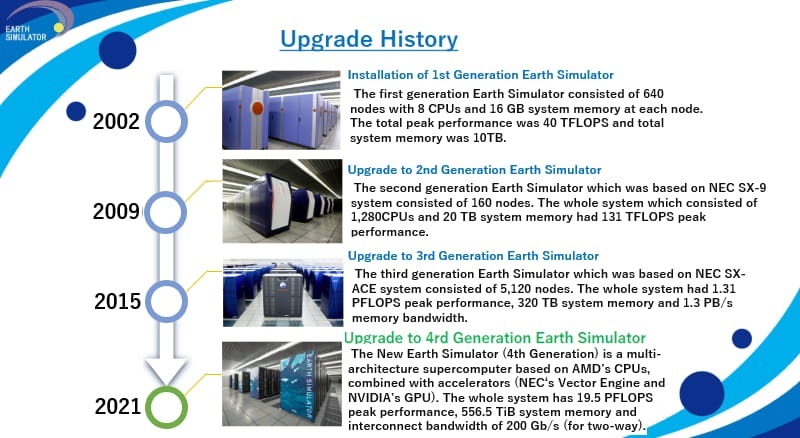
ES4 will lead both further development of conventional research and implementation of new research projects such as AI research.
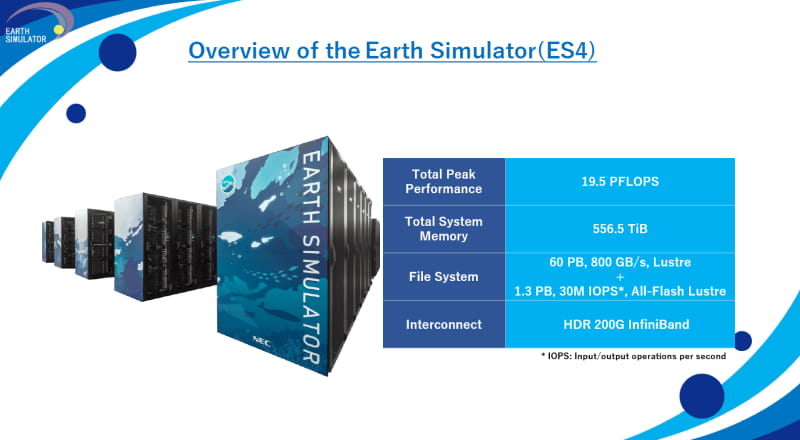
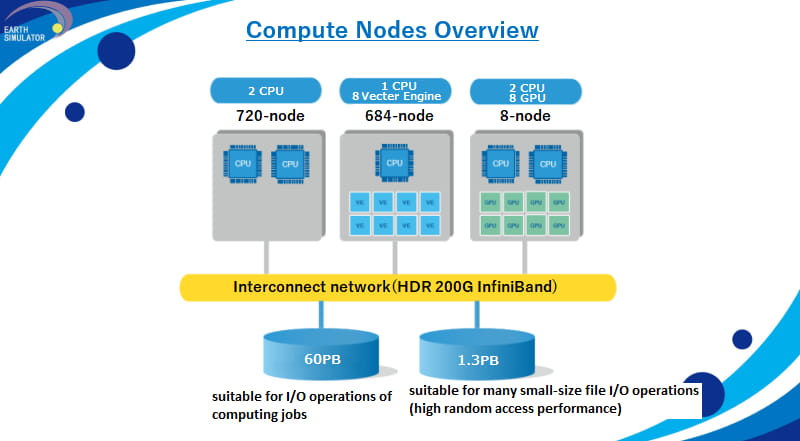
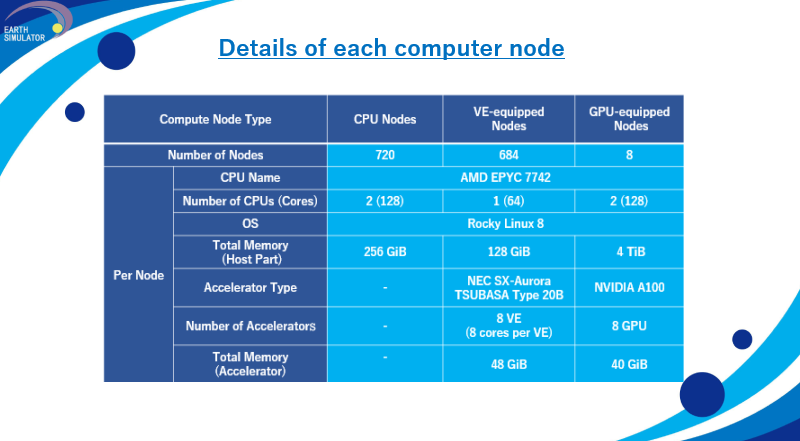
Besides, every node has the same kind of AMD EPYC CPU and Linux is installed on it.
Thus, this architecture allows users to run the jobs that uses all nodes or some nodes over the multiple clusters using the batch processing system which can manage all nodes.
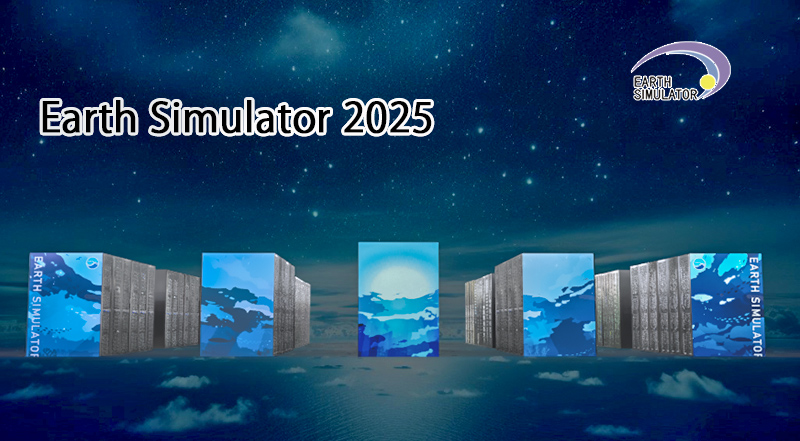 Earth Simulator (ES4) 3D installation model
Digital twins of the ocean are used to understand what is happening in the real space of the ocean, including natural disasters, and to predict what will happen.
Research Institute for Value-Added-Information Generation (VAiG) has been engaged the research and development of the ocean digital twin.
One of its objectives is to predict extreme weather and ocean phenomena such as super typhoons and storm surges.
We also envision the digital twin to investigate large earthquakes that occur in the ocean, using a seafloor observation network.
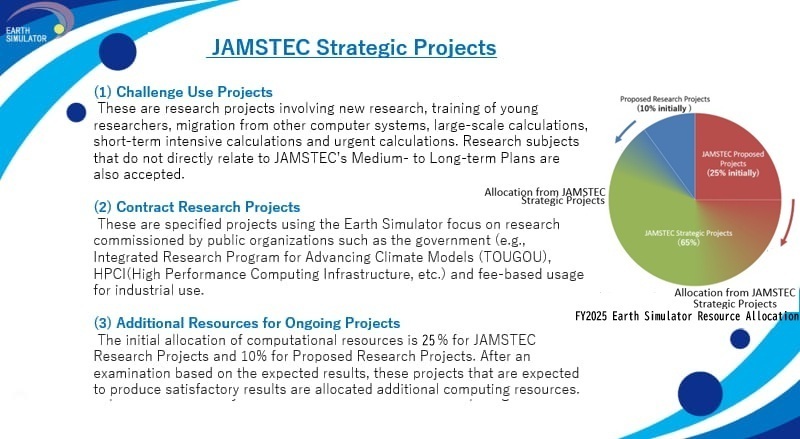
The category aims both adding computational resources to excellent researches at any time and the promotion of challenging researches.
It consists of the following three projects.
| Address | 236-0001 Yokohama Institute for Earth Sciences (YES), 3173-25, Showa-machi, Kanazawa-ku, Yokohama-city, Kanagawa, 236-0001, Japan |
|---|---|
| TEL | 045-778-5770 |
| FAX | 045-778-5771 |
| Web site, SNS | https://www.jamstec.go.jp/e/ |
Department of Earth and Environmental Sciences, Graduate School of Environmental Studies, Nagoya University
Department of Earth and Environmental Sciences, Graduate School of Environmental Studies, Nagoya University


The Department of Earth and Environmental Sciences in the Graduate School of Environmental Studies (EES-GSES) conducts basic research and education in the earth and environmental sciences, treating the entire planet as one whole system. Our aim is to develop new human resources with the ability to study, evaluate, and analyze the environments of the Earth based on sound scientific knowledge.
The EES-GSES members are primarily responsible for undergraduate education in the Department of Earth and Planetary Sciences in the Faculty of Science. The Department of Earth and Planetary Science was established in 1949 as the first “Department of Earth Sciences” in Japan, and was renamed the “Department of Earth and Planetary Sciences” in 1992 to reflect a new view of the Earth as a planet.
◆ Earth and Planetary Sciences
X https://x.com/eps_nagoyauniv
◆ Hydrospheric-Atmospheric Science
X https://x.com/eps_nagoyauniv
◆ Faculty Members
Pamphlet
Global 30 International Graduate Program (Master's, Doctoral)
| Address | 464-8601 Department of Earth and Environmental Sciences, Graduate School of Environmental studies, Nagoya University, Furo-cho, Chikusa-ku, Nagoya 464-8601, Japan |
|---|---|
| Web site, SNS | https://ees.env.nagoya-u.ac.jp/en/index.html |
reserved
reserved
Contents
Contents
Download
Contents
①× ×, 2021(×)13:00~14:00
②× ×, 2021(×)13:00~14:00
Please click here to contact us (Zoom will start)