Presentation Information
[R1P-14]Balkanite from the No. 11 ore body of Shakanai mine, Akita prefecture, Japan
*Takahiro TANAKA1, Daisuke Nishio Hamane2 (1. Nittetsu Mining Consultants Co., Ltd., 2. ISSP, Univ. of Tokyo)

Keywords:
balkanite,mercury,Shakanai mine,Kuroko,seafloor hydrothermal deposit
Massive sulfide deposits, including Kuroko deposits and modern seafloor hydrothermal deposits, are enriched not only in Zn, Pb, and Cu but also in trace elements such as Cd, Ag, Sb, As, and Hg. In Kuroko deposits, mercury is mainly hosted by tetrahedrite-group minerals, as well as sphalerite, galena, and pyrite, whereas in modern seafloor hydrothermal deposits it also occurs as cinnabar. Balkanite (Cu9Ag5HgS8) is a rare Cu-Ag-Hg sulfosalt mineral that crystallizes from low-temperature hydrothermal fluids during the latest stage of hydrothermal mineralization.
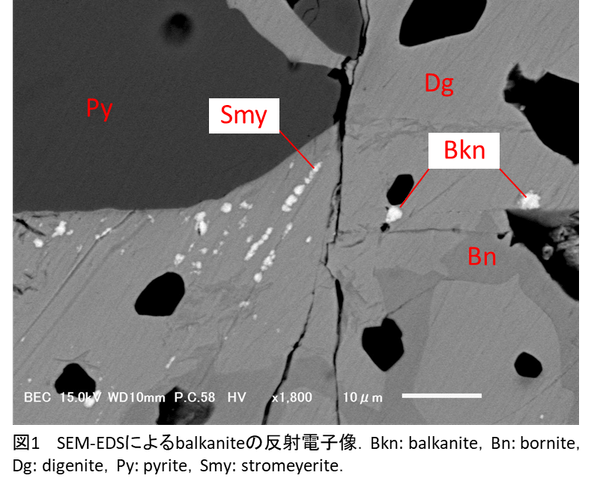
In the No. 11 orebody of the Shakanai mine, balkanite occurs as grains smaller than 5 um in association with stromeyerite within ores composed mainly of bornite, digenite, and pyrite, with minor sphalerite, chalcopyrite, galena, and enargite. SEM-EDS analyses yielded an empirical formula of Cu9.00Ag5.05(Hg0.62Fe0.25Cu0.21)Σ1.08S7.87. The characteristic occurrence of digenite and enargite, together with the coexistence of bornite and pyrite, suggests, based on the sulfidation-state diagram of Einaudi et al. (2003), that the ore formed under lower-temperature conditions than typical base-metal-rich Kuroko ores. Accordingly, balkanite of the Shakanai mine is interpreted to have crystallized from Ag- and Hg-rich hydrothermal fluids in the low-temperature part of a seafloor hydrothermal system during the latest stage of mineralization, consistent with the interpretation of Vasil et al. (1973). These results suggest that, in Ag-rich zones characterized by high-sulfidation-state minerals and mineral assemblages in Kuroko deposits and modern seafloor hydrothermal deposits, mercury may occur in the form of balkanite.
In the No. 11 orebody of the Shakanai mine, balkanite occurs as grains smaller than 5 um in association with stromeyerite within ores composed mainly of bornite, digenite, and pyrite, with minor sphalerite, chalcopyrite, galena, and enargite. SEM-EDS analyses yielded an empirical formula of Cu9.00Ag5.05(Hg0.62Fe0.25Cu0.21)Σ1.08S7.87. The characteristic occurrence of digenite and enargite, together with the coexistence of bornite and pyrite, suggests, based on the sulfidation-state diagram of Einaudi et al. (2003), that the ore formed under lower-temperature conditions than typical base-metal-rich Kuroko ores. Accordingly, balkanite of the Shakanai mine is interpreted to have crystallized from Ag- and Hg-rich hydrothermal fluids in the low-temperature part of a seafloor hydrothermal system during the latest stage of mineralization, consistent with the interpretation of Vasil et al. (1973). These results suggest that, in Ag-rich zones characterized by high-sulfidation-state minerals and mineral assemblages in Kuroko deposits and modern seafloor hydrothermal deposits, mercury may occur in the form of balkanite.