


Exhibitors③
Ehime University, Geodynamics Research Center
Ehime University, Geodynamics Research Center

Geodynamics Research Center (GRC) is an international research institute where researchers conduct leading-edge studies on materials and states of the Earth's deep interior in order to reveal dynamics and evolution of the Earth and planets, based on advanced high-pressure experiments and numerical simulations. We investigate various issues of the Earth and planetary sciences, chemical composition of the Earth's lower mantle, materials and structures of the Earth's core, Earth's deep water, internal structure of solar planets and exoplanets and dynamics of the planetary interior, and expand our techniques and knowledge to a field of material sciences for synthesizing novel useful materials such as the world-hardest material "HIME-Diamond".
The radius of the Earth is about 6,400 km, but only 10 km depth is achieved by drillings. The Earth's deep interior is an unreachable place where pressure and temperature at the center are estimated to be respectively 360 GPa and 5000 K or higher. Thus, high-pressure and temperature experiments and numerical simulations are essential tools to study dynamics and composition under such extreme conditions. Developments of the techiniques at GRC lead to an innovative area of high-pressure materials sciences; syntheses of newly novel materials which are obtainable only by high pressure experiments.
◆PRIUS: Premier Research Institute for Ultrahigh-pressure Sciences
GRC operates PRIUS from 2013 which is one of the "Joint Usage / Research Centers" in Japan authorized by the Ministry of Education, Culture, Sports, Science and Technology. Missions of PRIUS, as an international education and research hub, are to conduct Earth and planetary science and material science research by using the high-pressure techniques with the objective of creating new fields of science thorough the international collaborations and interdisciplinary networks of researchers.
GRC conducts experiments under conditions of ultra high pressure and high temperature experiments of the Earth's and planetary deep interiors by using two types of high-pressure generationg appaturs: Munti-anvil high-pressure apparatus and Diamond anvil cell apparatua. GRC is equipped with several types of Multi-anvil apparatus, including the world-largest class one of 6000-ton press, BOTCHAN.
◆Phase transitions of minerals
A “phase transition” is characterized by the change of configuration of a toms in mineral by the effect of pressure. Diamond is a high pressure form of graphite, whose phase transition occurs at 5 GPa (150 km depth). Measurements of the conditions where the phase transitions occur and changes of the physical properties of minerals (density, sound velocity, chemical properties etc) accompanying the phase transition bring fruitful information for understandings of the Earth's deep structure and materials.
◆Numeral simulations
Ab initio computations: Theoretical and computational investigation on the
ultrahigh-pressure behaviors of materials in the Earth and planets are conducted by using computer simulations based on quantum mechanics.
Fluid mechanics computation: Numerical simulations based on the fluid and continuum mechanics are conducted to reveal the convective motions in the mantle and core of the Earth and terrestrial planets for the understandings of the dynamics and evolution processes of the planets. Large scale computations using realistic parameters of the Earth, phase transitions, viscosity and compression behaviors under high pressure, are performed for 3-D spherical-geometry simulations.
HIME-Diamond synthesized in GRC is the hardest diamond and likely the hardest material in the world. Unlike normal diamond made of a single
crystal, HIME-Diamond consists of closely-packed nanometer-sized diamonds (~10 nanometers = one hundred-thousandth millimeters). Thus the HIME-Diamond is also called "Nano-polycrystalline diamond (NPD)".
◆Toward higher pressure generations
Experiments under higher pressure are of importance to investigate the interiors of the Earth and planets. The harder the compression material is, the higher the pressure we can reach and thus HIME-Diamond plays a
major role in future development of experiments at ultrahigh pressure. The high transparency of HIME-Diamond enables high-pressure experiments using optical in-situ observations and synchrotron radiations.
◆Novel polycrystalline materials and gems
GRC conducts syntheses of novel polycrystalline materials by applying techniques learned from making of HIME-Diamond. Nano-polycrystalline
stishovite (NPS) made from silica (SiO2) is one of the novel materials synthesized by GRC. NPS shows excellent physical properties having both hardness and toughness. Garnets (one of the main constituents within the Earth) with a variety of chemical compositions can be synthesized as nano-polycrystalline materials.
| Address | 790-8577 2-5 Bunkyo-cho, Matsuyama, Ehime, 790-8577 Japan |
|---|---|
| TEL | 089-927-8165 |
| Web site, SNS | https://grc.ehime-u.ac.jp/en/ |
Enabler LTD.
Enabler LTD.

It contributes to the acquisition of positioning and time information in the field of earth science and in the field of mobile objects such as automobiles, ships, construction machinery, and agricultural machinery.


Please ask the person in charge for details such as specifications.

With tolerance to harsh radio wave reception environments, PolaRx5, which has been adopted by UNAVCO and IGS, We will propose a sales price for academics.

We will also exhibit the TRIUMPH-3NR, which is lightweight and compact and convenient to carry.

Introducing models compatible with QZSS L6.
We will also exhibit a real-time positioning device that combines GNSS/IMU/camera.

We will also introduce a simulator that generates GNSS signals.

Those who like field activities, those who have experience with GNSS and other precision instruments and software for researchers, and data, those who are interested in cutting-edge technology, those who have experience in data analysis, and those who have an inquisitive mind. who have Please feel free to contact Ito (itoh@enabler.co.jp)!
It doesn't matter whether you are a college or graduate school graduate.
We also accept requests for internships.
| Address | 160-0022 Sawada Bldg. 9F, 1-15-9, Shinjuku, Shinjuku-Ku, Tokyo , Japan |
|---|---|
| TEL | 080-8865-5722 |
| FAX | 03-6800-3305 |
| Web site, SNS | https://www.enabler.co.jp/en/ |
iRIC
iRIC

| Address | 1680082 REDROCKS R-013, 3-36-3, Kugayama, Suginamiku, Tokyo |
|---|---|
| TEL | 03-6379-2027 |
| Web site, SNS | https://uc.i-ric.org/ |
Asia Air Survey co., ltd.
Asia Air Survey co., ltd.


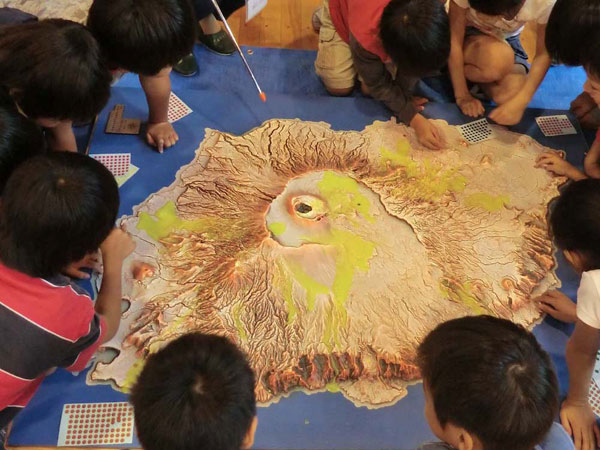
Twenty years have passed since its invention, and while the initial patents have expired, the improvement patents developed in the meantime are still valid. Here, we introduce the latest information on the "Red Relief Image Map" used in various forms.

In collaboration with Weathercock Co., Ltd. in Sapporo, we have developed precise projection mapping on red relief image maps. Using a 1:10,000 scale model of Mount Usu, we will conduct demonstrations with geological maps, hydrological maps, and video projections.
Cool Map
Maps should be laid on the floor. COOLMAP overlays black slope maps from DSM with color-coded building heights, topped with red relief image maps. Viewing this map gives you the sensation of flying in the sky. Patents have been obtained both domestically and internationally.

Analog Model Experiments
In geoscience, where full-scale experiments are difficult, analog model experiments are often conducted. This time, we will conduct our usual shampoo lava experiment and urethane eruption experiment on red relief image map models.
VR Experience
Let's view the 3D measurement results in 3D. You can experience a demonstration using a head-mounted display currently under development.
| Address | 215-0004 1-2-2,manpukuji,asao-ku,kawasaki-city,kanagawa pref.Japan |
|---|---|
| Web site, SNS | https://www.ajiko.co.jp/en/ |
TCGU
TCGU

The Chinese Geoscience Union in Taiwan (TCGU) is a comprehensive organization for earth science professionals and practitioners. Established in 1993, TCGU and the publisher, Springer Nature, collaborate to publish Terrestrial, Atmospheric and Oceanic Sciences Journal (TAO) which is Taiwan's major international journal in earth sciences.
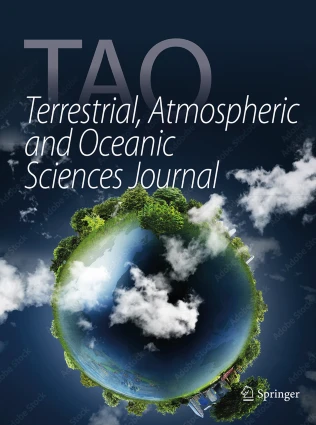
TAO is an SCI-accredited journal publishing original scientific articles, reviews, notes and correspondence in all disciplines of the Earth sciences, including Geophysics, Geology, Atmospheric Science, Space Science, Oceanic Science and Hydrology.
TAO is co-sponsored by the Geological Society, the Geophysical Society, the Meteorological Society, and the Oceanographic Society and has its publication partially subsidized by the Ministry of Science and Technology in Taiwan.
TAO has published its very first issue in 1990 and has become the official journal of the Chinese Geoscience Union since 1993. Started from January 2022, TAO has become a publication under Springer Nature and has changed its publication mode to Continuous Article Publishing.

TGA is the triennial meeting organized by multiple earth sciences related societies in Taiwan. The next TGA is scheduled to be held in Taipei from May 12 to 16, 2025.
As a comprehensive meeting, TGA provides an excellent opportunity for participants to see nature from both sub-disciplinary and interdisciplinary points of view. Most important, it is hoped that the discussions will help raising the awareness of geosciences in the local public.
| Address | 106923 P.O. Box 59 National Taiwan University, Taipei, Taiwan |
|---|---|
| TEL | +886-2-2363-2583 |
| FAX | +886-2-8369-1297 |
| Web site, SNS | http://www.cgu.org.tw/index.php/en-home |
Asia Oceania Geosciences Society (AOGS)
Asia Oceania Geosciences Society (AOGS)
About
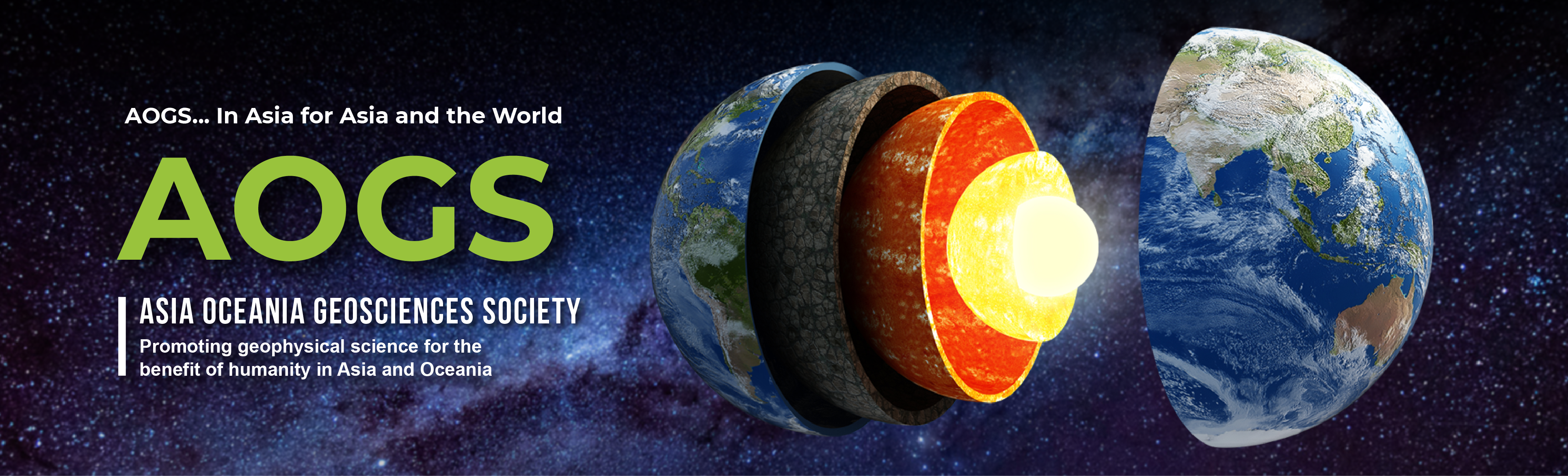
Asia Oceania Geosciences Society (AOGS) was established in 2003 to promote geosciences and its application for the benefit of humanity, specifically in Asia and Oceania and with an overarching approach to global issues. Asia Oceania region is particularly vulnerable to natural hazards, accounting for almost 80% human lives lost globally. AOGS is deeply involved in addressing hazard related issues through improving our understanding of the genesis of hazards through scientific, social and technical approaches. AOGS holds annual conventions providing a unique opportunity of exchanging scientific knowledge and discussion to address important geo-scientific issues among academia, research institution and public. Recognizing the need of global collaboration, AOGS has developed good co-operation with other international geo-science societies and unions such as the European Geosciences Union (EGU), American Geophysical Union (AGU), International Union of Geodesy and Geophysics (IUGG), Japan Geo-science Union (JpGU), and Science Council of Asia (SCA).
Upcoming Events


| Address | Singapore 149544 1 Commonwealth Lane, #06-23, One Commonwealth |
|---|---|
| TEL | +65 6472 3108 |
| Web site, SNS | https://www.asiaoceania.org |
EPS
EPS

publishing with Springer-Nature
Impact Factor (2022): 3.0
5-year IF (2022): 2.7
CiteScore: 4.9
H Index: 85
Rapid peer review and publication
14 days submission to first editorial decision for all manuscripts (Median)
162 days submission to accept (Median)
[in 2023]
Article Type
Full Paper without word limit.
Express Letter has a limit of 5000 words including the main text, figure legends and table legends. The sum of the number of figures and tables should be less than or equal to 5.
Frontier Letter can be submitted upon invitation by the Editor-in-Chief.
Technical Report describes the technical development of instrument or software.
Comment is a substantial re-analysis of a previously published article in the journal.
“Express Letter”
Express Letters provide you with a fast turnaround time, while maintaining rigorous peer review.
From submission to first decision, the shortest time is 19 days, and the average is 45 days (based on 2023 data).
"Technical Report"
Technical Reports present a software tool or an experimental or computational method, test or procedure, or hardware design.
Special Issues
We welcome proposals for special issues.
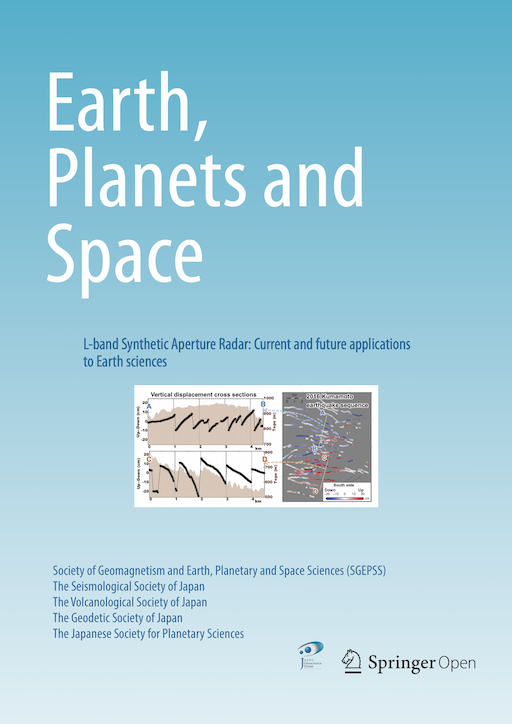
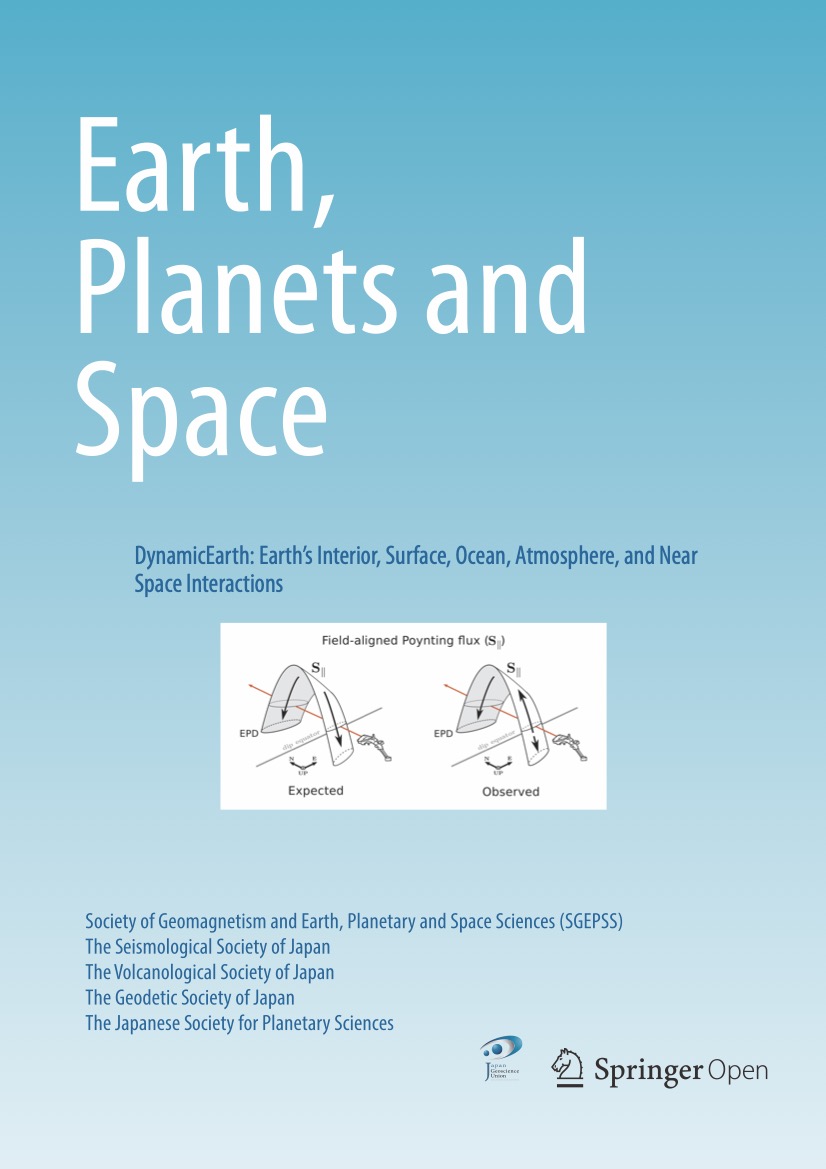
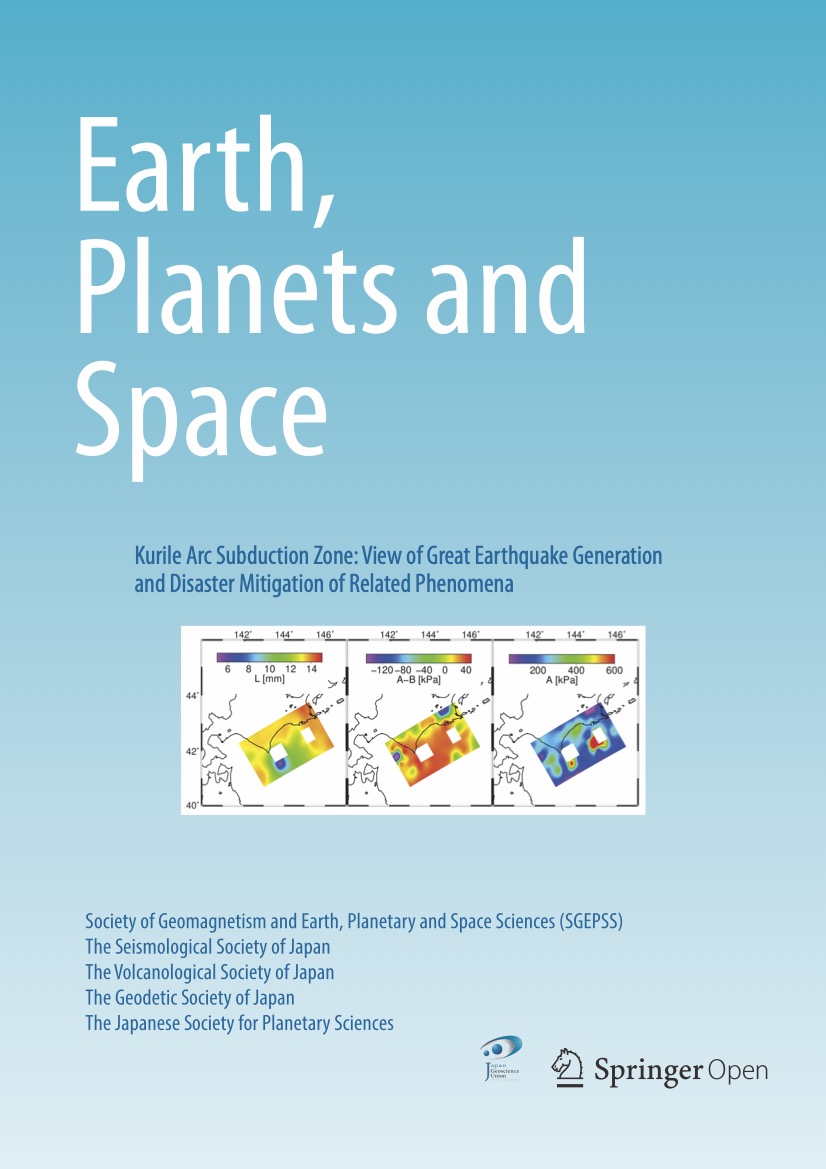
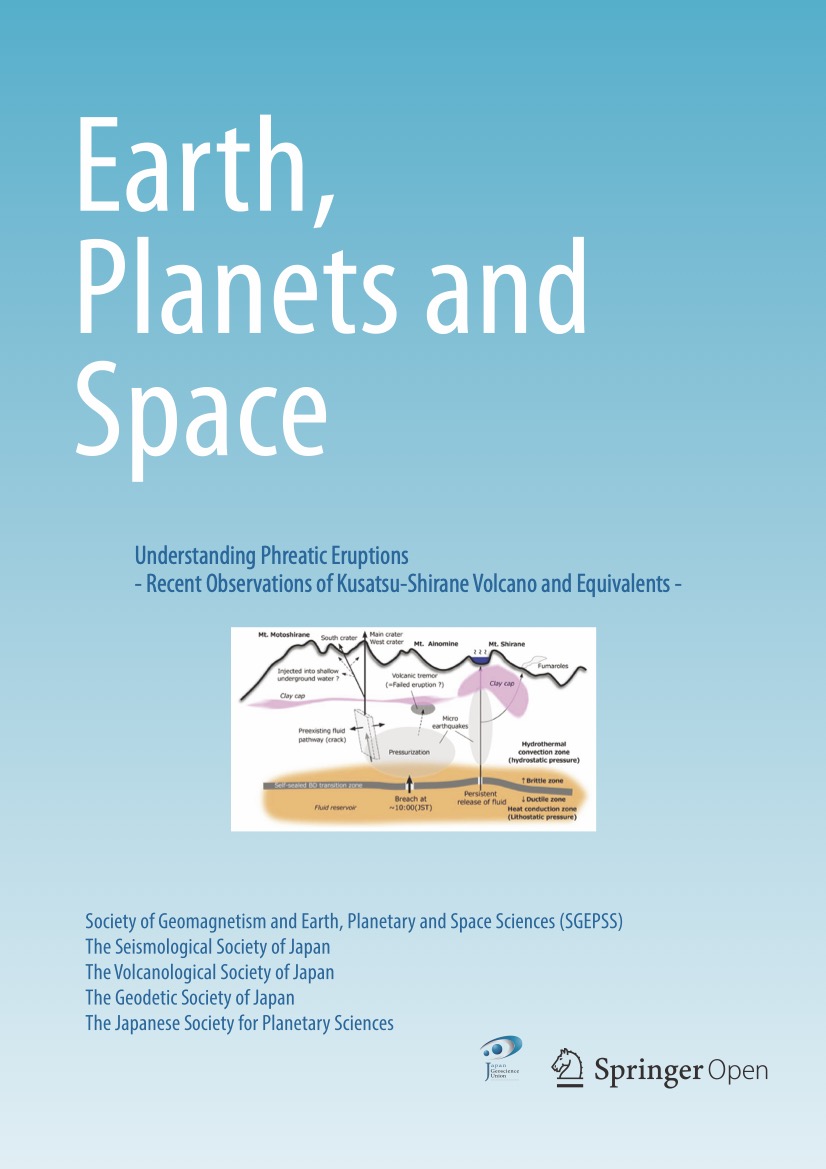
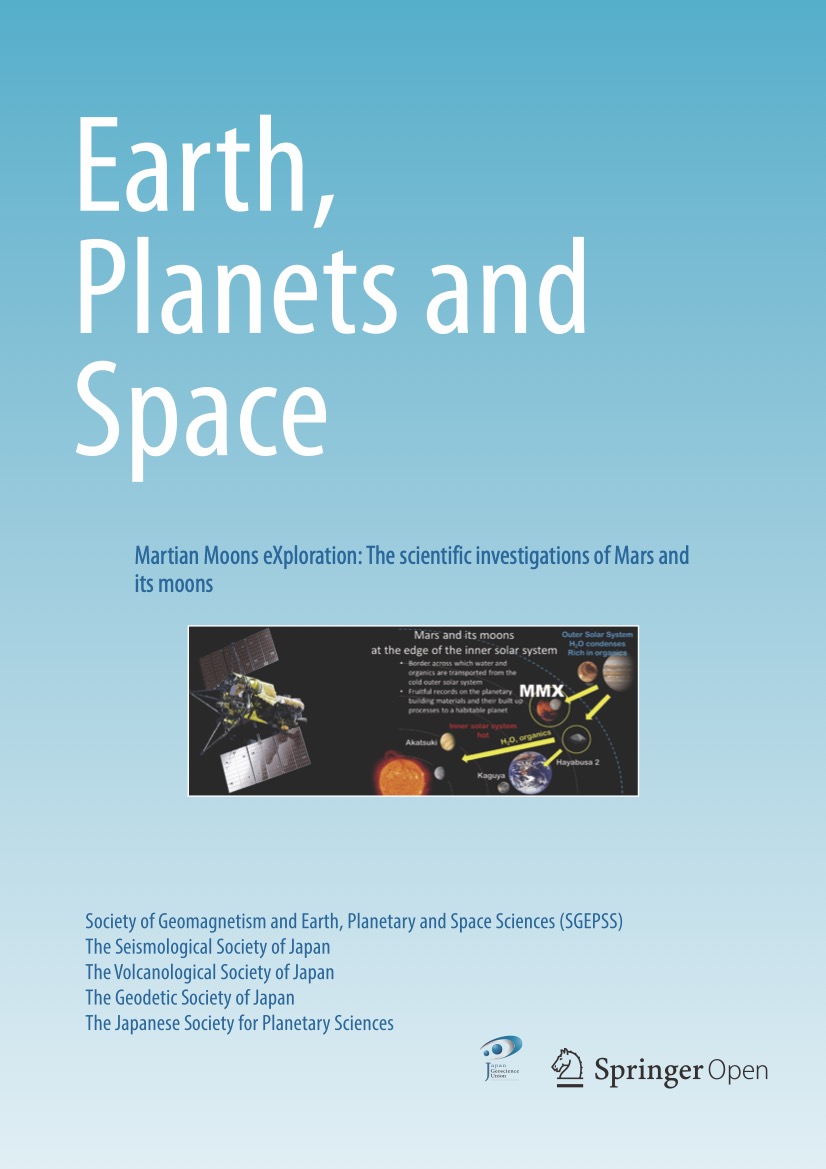
Submit your paper to journal EPS
Article Processing Charge
Non-Members $1,590
Members* $1,283.93
(*) The APC for members is applicable when a corresponding author belongs to any of the five societies that co-publish EPS.
Editor in Chief
Takeshi Sagiya
Nagoya University, Japan
Vice Editors-in-Chief
Masahito Nosé Aitaro Kato
Advisory Board
Editorial Board

| Web site, SNS | https://www.earth-planets-space.org/en/ |
|---|
Japan Geoscience Union
Japan Geoscience Union
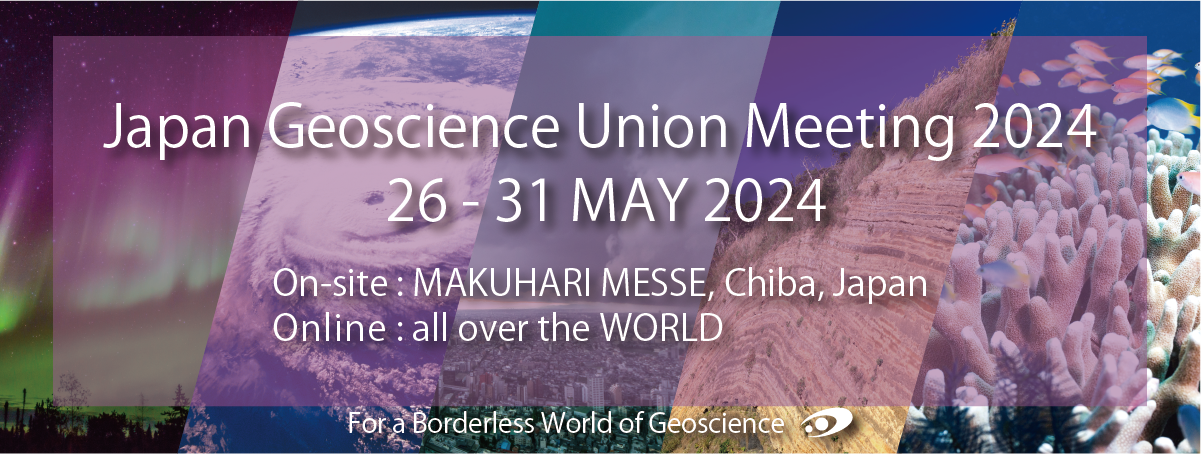
JpGU2024 will be held as a hybrid format (on-site and online) next May at the Makuhari Messe, Chiba Prefecture, Japan, It is aimed that all participants can attend JpGU2023 at the conference rooms and/or from anywhere through network. This is a first attempt for JpGU.


Hello, my name is " Chiwaku-kun".
Please follow JpGU's SNS !
| Web site, SNS | https://www.jpgu.org/en/ |
|---|
PEPS
PEPS
<div style="margin: 10px 0px 16px;padding: .25em 0 .5em .75em;border-left: 6px solid #a4d4ec;border-bottom: 1px solid #a4d4ec;font-size: 1.2em;font-weight:bold"><span style="color:#3300ff"><strong>Progress in Earth and Planetary Science </strong>(PEPS)</span><img alt="Stamp" src="https://www.jpgu.org/PEPS/JpGU2022/QuizeSTAMP.png" style="float:right; height:30px; width:80px" /></div>
<br />
<a href="http://progearthplanetsci.springeropen.com/">PEPS</a> is a peer-reviewed open access e-journal of the Japan Geoscience Union (JpGU), published in collaboration with its 51 society members, and deals with scientific articles in the earth and planetary sciences. PEPS was launched in 2014.
<div style="margin: 10px 0px 16px;padding: .25em 0 .5em .75em;border-left: 6px solid #a4d4ec;border-bottom: 1px solid #a4d4ec;font-size: 1.2em;font-weight:bold"><span style="color:#3300ff"><strong>Fields Covered:</strong></span></div>
PEPS publishes papers in each of <a href="https://www.jpgu.org/PEPS/JpGU2022/PEPS_covered_Fields.mp4">the six JpGU science sections</a> which are:<br />
<br />
<a href="https://www.jpgu.org/PEPS/JpGU2022/PEPS_covered_Fields.mp4"><img alt="coverd_area" src="https://www.jpgu.org/PEPS/JpGU2022/PEPS_Fields.png" style="float:left; height:130px; margin:2px 10px; width:200px" /></a> - Space and Planetary Sciences <br />
- Atmospheric and Hydrospheric Sciences<br />
- Human Geosciences <br />
- Solid Earth Sciences -Biogeosciences<br />
- Interdisciplinary research (research which covers <br />
two or more of the other five science sections)
<ul><br />
<li> Recently, there has been increased in submitting papers for Interdisciplinary research section that across multiple research fields, centering on study of natural hazard. </li>
</ul>
<a href="https://www.jpgu.org/PEPS/JpGU2022/PEPS_covered_Fields.mp4" style="font-size: 16px;">Click here to see examples of articles in each field</a>
<ul><br />
<li> </li>
</ul>
<ul>
</ul>
<div style="margin: 10px 0px 16px;padding: .25em 0 .5em .75em;border-left: 6px solid #a4d4ec;border-bottom: 1px solid #a4d4ec;font-size: 1.2em;font-weight:bold"><span style="color:#3300ff"><strong>Types of Article:</strong></span></div>
PEPS is devoted to high-quality original articles, reviews and papers with full data attached. PEPS promotes excellent <strong>review articles</strong> and welcomes articles with electronic attachments including videos, animations, and large original data files. PEPS also encourages <strong>papers with full data attached: papers</strong> with full data attached are scientific articles that preserve the full detailed raw research data and metadata which were gathered in their preparation and make these data freely available to the research community for further analysis.<br />
<br />
<a href="http://www.jpgu.org/PEPS/ReviewAbstracts/PEPS_ReviewAbstracts2024_e.pdf"><img alt="REview" src=" https://media.springernature.com/lw725/springer-cms/rest/v1/content/27021158/data/v1" style="float:left; height:112px; margin:5px 10px; width:79px" /></a><br />
About 20% of our articles are review articles which provide a systematic summary of the newest developments in the fields that they cover.<br />
Now, we have released <a href="/www.jpgu.org/PEPS//ReviewAbstracts/PEPS_ReviewAbstracts2024_e.pdf">the 3rd edition of a collection of abstracts of the published PEPS Review Articles</a><a href="https://www.jpgu.org/PEPS/ReviewAbstracts/PEPS_ReviewAbstracts2024_e.pdf">.</a><br />
<br />
<br />
<div style="margin: 10px 0px 16px;padding: .25em 0 .5em .75em;border-left: 6px solid #a4d4ec;border-bottom: 1px solid #a4d4ec;font-size: 1.2em;font-weight:bold"><span style="color:#3300ff"><strong>Citation Impact 2022:</strong></span></div>
<span style="color:rgb(51, 51, 51)"> - Impact Factor: 3.9 ( 2-year Impact Factor) </span><br />
<span style="color:rgb(51, 51, 51)"> - Impact Factor: 4.1 ( 5-year Impact Factor) </span><br />
<span style="color:rgb(51, 51, 51)"> - Scopus/CiteScore: 7.0</span><br />
<span style="color:rgb(51, 51, 51)"> - SJR: 1.529 ( SCImago Journal Rank )</span><br />
<span style="color:rgb(51, 51, 51)"> - SNIP: 1.143 (Source Normalized Impact per Paper)</span>
<div style="margin: 10px 0px 16px;padding: .25em 0 .5em .75em;border-left: 6px solid #a4d4ec;border-bottom: 1px solid #a4d4ec;font-size: 1.2em;font-weight:bold"><span style="color:#3300ff"><strong>APC (Article Processing Charge ):</strong></span></div>
- JpGU Member: US$1432/ € 1192/ £ 1032 --- 20 % discount<br />
- JpGU Non-Member: US$1,790/ €1,490/ £1,290<br />
- Review article: ;US$1432/ € 1192/ £ 1032 --- 20 % discount<br />
- Invited article: JpGU bears all costs. --- 100% discount
<div style="margin: 10px 0px 16px;padding: .25em 0 .5em .75em;border-left: 6px solid #a4d4ec;border-bottom: 1px solid #a4d4ec;font-size: 1.2em;font-weight:bold"><span style="color:#3300ff"><strong>SPEPS(SPecial call for Excellent Papers on hot topicS)<br />
article collections</strong><strong>:</strong></span></div>
<a href="https://progearthplanetsci.springeropen.com/articles/collections">SPEPS is an open-type special issue</a> that Progress in Earth and Planetary Science (PEPS) provides aiming to publish presentations delivered at the Japan Geoscience Union Annual Meetings, international symposiums, and the results of research projects etc.<br />
<br />
<span style="color:#0000FF">SPEPS article collection in progress open for submission:</span><br />
<br />
<img alt="tohoku" src="https://media.springernature.com/lw725/springer-cms/rest/v1/content/25201278/data/v1" style="background-attachment:initial; background-clip:initial; background-image:initial; background-origin:initial; background-position:initial; background-repeat:initial; background-size:initial; border:0px; color:rgb(51, 51, 51); cursor:default; float:left; font-family:lucida grande,arial,hiragino kaku gothic pron,meiryo,sans-serif; font-size:16px; height:116px; margin:2px 15px; outline:0px; padding:0px; width:200px" />
<div><a href="https://www.springeropen.com/collections/PvAm">Past variability of Asian monsoon and its influence on surrounding regions on various timescales</a><br />
<br />
We are also looking for new SPEPS proposals.<br />
Please consider SPEPS collections as an effective method to make public session presentations at JpGU Meeting 2023 or results of research projects.<br />
<br />
Contact and Inquiries: PEPS office <a href="mailto:peps_edit@jpgu.org">peps_edit@jpgu.org</a><br />
<br />
<br />
<br />
| Address | 113-0032 2-4-16-4F Yayoi, Bunkyo-ku, 113-0032 Tokyo,Japan |
|---|---|
| Web site, SNS | https://progearthplanetsci.springeropen.com/ |
European Geosciences Union (EGU)
European Geosciences Union (EGU)

The European Geosciences Union (EGU) is the leading organisation for Earth, planetary and space science research in Europe. EGU publishes a number of diverse scientific journals and its annual General Assembly is the largest European geosciences event.
| Address | 81677 Kastenbauerstr. 2, Munich, Germany |
|---|---|
| TEL | +49-89-2050 76300 |
| FAX | +49-89-2050 76399 |
| Web site, SNS | https://www.egu.eu |
The Geodetic Society of Japan
The Geodetic Society of Japan
Department of Earth and Planetary Sciences, Kyushu University
Department of Earth and Planetary Sciences, Kyushu University
2024年度パンフレット 公式WEBサイト
九州大学の理学部地球惑星科学科・大学院理学府地球惑星科学専攻は、全国的に見ても規模が大きく、幅広い分野をカバーしています。物理や数学を主に使う分野もあれば、化学実験をじっくり行う分野もあります。野外に飛び出して地層や海洋調査をする分野もあります。必ずどこかで自分の得分野を活かせます。
理学部 地球惑星科学科 入学案内(公式サイト)
学部の教育課程では、高校で地学を履修していないことを前提として内容が設定されていますので、高校で地学を履修していなくても心配ありません。物理・化学・生物関係の科目についても、高校で履修しなかった人でもついていけるように配慮されています。基幹教育科目(教養科目)から専攻教育科目を履修して、研究室へ配属され、特別研究(卒業研究)を実施します。
大学院理学府 地球惑星科学専攻 入学案内(公式サイト)
大学院修士課程では、先端研究者を目指すフロントリサーチャー育成プログラム(FR)と、社会で活躍する理学専門家を目指すアドバンストサイエンティスト育成プログラム(AS)のいずれかに配属され、複数の指導教員によるきめ細かい指導がおこなわれます。
模擬授業・研究室紹介・研究室の選び方・就職情報・ちわくギャラリー
「九州大学理学部地球惑星科学科のオープンキャンパスへようこそ!オンラインでもちわくのことを知ることができる内容がもりだくさん!さあ、ちわくの世界へ出かけよう!」
学科紹介(動画)
学科カリキュラム紹介(動画)
| Address | 819-0395 福岡県福岡市西区大字元岡744番 |
|---|---|
| TEL | 092-802-4209 |
| FAX | 092-802-4208 |
| Web site, SNS | https://www.geo.kyushu-u.ac.jp/department/ |
JAMSTEC Earth Simulator
JAMSTEC Earth Simulator

ES4 will lead both further development of conventional research and implementation of new research projects such as AI research.
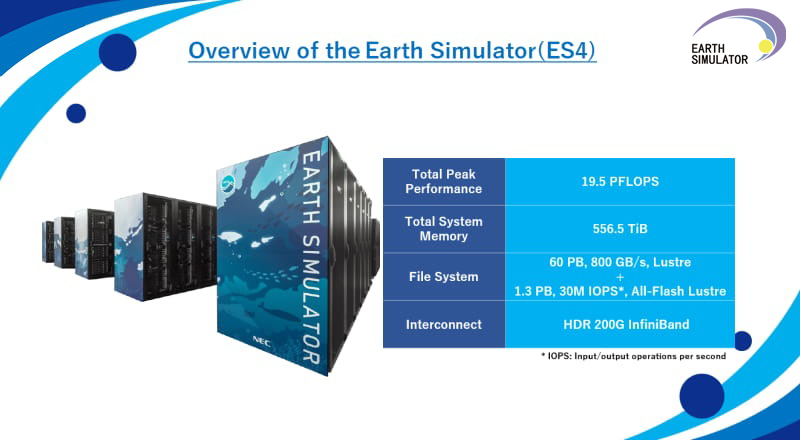
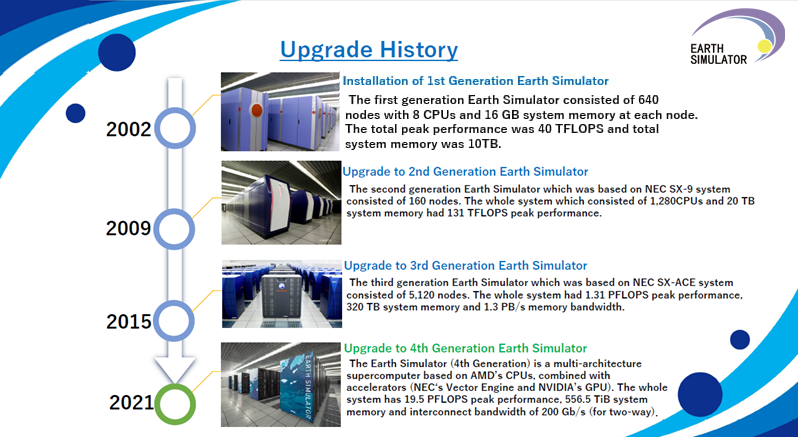
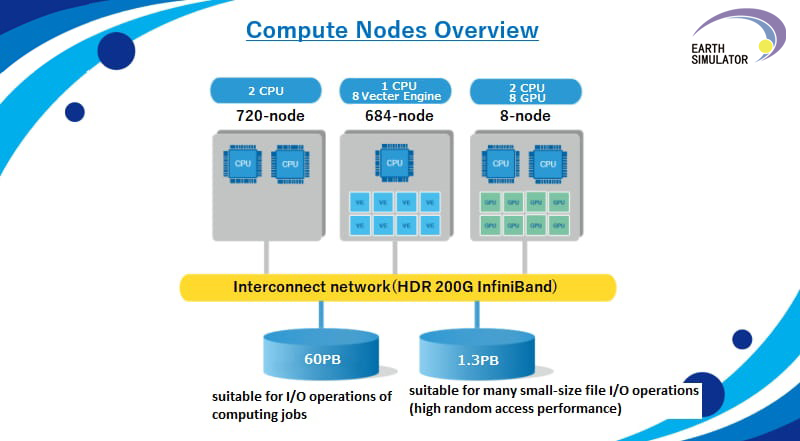
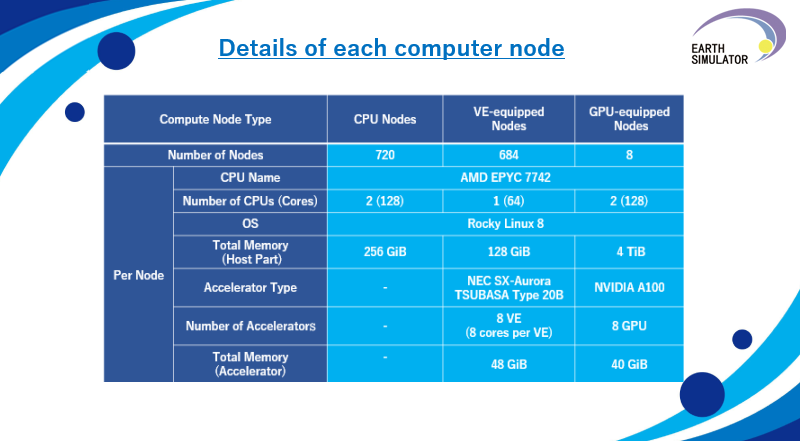
Besides, every node has the same kind of AMD EPYC CPU and Linux is installed on it.
Thus, this architecture allows users to run the jobs that uses all nodes or some nodes over the multiple clusters using the batch processing system which can manage all nodes.
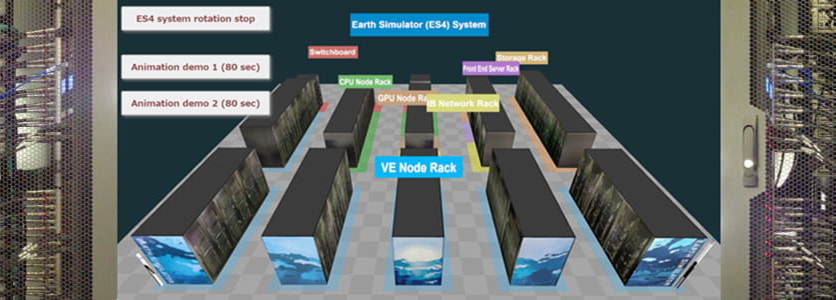 Earth Simulator (ES4) 3D installation model
Digital twins of the ocean are used to understand what is happening in the real space of the ocean, including natural disasters, and to predict what will happen.
Research Institute for Value-Added-Information Generation (VAiG) has been engaged the research and development of the ocean digital twin.
One of its objectives is to predict extreme weather and ocean phenomena such as super typhoons and storm surges.
We also envision the digital twin to investigate large earthquakes that occur in the ocean, using a seafloor observation network.
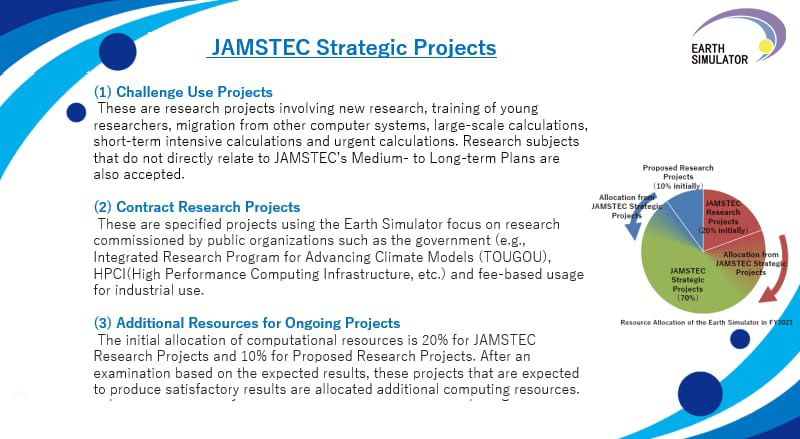
The category aims both adding computational resources to excellent researches at any time and the promotion of challenging researches.
It consists of the following three projects.
| Address | 236-0001 Yokohama Institute for Earth Sciences (YES), 3173-25, Showa-machi, Kanazawa-ku, Yokohama-city, Kanagawa, 236-0001, Japan |
|---|---|
| TEL | 045-778-5770 |
| FAX | 045-778-5771 |
| Web site, SNS | https://www.jamstec.go.jp/e/ |
Department of Geography, Tokyo Metropolitan University
Department of Geography, Tokyo Metropolitan University

| Address | 192-0397 Minami-osawa 1-1, Hachioji, Tokyo |
|---|---|
| TEL | 042-677-2588 |
| FAX | 042-677-2589 |
| Web site, SNS | https://www.ues.tmu.ac.jp/geog/en/ |
Nsdesign Co., Ltd.
Nsdesign Co., Ltd.
Deep-time Digital Earth
Deep-time Digital Earth
Japan Organization for Metals and Energy Security
Japan Organization for Metals and Energy Security

| Address | 105-0001 東京都港区虎ノ門2-10-1 虎ノ門ツインビルディング |
|---|---|
| TEL | 03-6758-8000 |
| FAX | 03-6758-8008 |
| Web site, SNS | http://www.jogmec.go.jp/ |